During OFC 2024, the focus was on the next speed of optical connections, 1.6T, with Keysight showcasing a 1.6T optical link between an arbitrary waveform generator and a bit-error-rate tester. Fast forward to OFC 2025, where many companies displayed 1.6T pluggable optical modules, emphasizing the role of AI in driving engineers to develop higher data rates per connection.
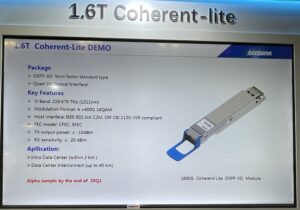
1.6T optical modules were on display at many OFC 2025 booths.
With AI stressing networks for higher data rates, the shift from 200G to 400G is underway, with 800G deployment ready and 1.6T standards expected in the future. The industry is also exploring technologies like co-packaged optics to overcome bandwidth limitations.

(l-r) Alan Weckel, 650 Group; Craig Thompson, NVIDIA; Don Barnetson, Credo; Nathan Tracy, OIF and TE Connectivity; Josef Berger, Marvell.
Discussions at OFC 2025 highlighted the importance of front pluggable modules and the emergence of active electrical cables as viable alternatives to optical cables in certain scenarios. The industry is also exploring cable backplanes for interconnecting GPUs and switches at higher data rates.
As the demand for bigger and faster networks grows due to AI, considerations for power delivery and cooling become critical. Engineers are exploring innovative solutions like low-power optical modules to address future challenges as data rates continue to increase.
1.6T is already too slow

A slide from NVIDIA at OFC 2025 shows the future move from 1.6T to 3.2T will likely invoke more power and cooling issues.
As the industry looks towards 3.2T, the focus shifts to developing low-power optical modules to address future power and cooling challenges. The transition from 1.6T to 3.2T will require innovative solutions to dissipate heat effectively and ensure optimal performance.