DRX, also known as Discontinuous Reception, is a power-saving feature in LTE networks aimed at prolonging the battery life of user equipment (UE) like smartphones. This article will delve into the role of the Physical Downlink Control Channel (PDCCH) in LTE within the context of DRX. It will then outline the complete DRX process, covering short/long DRX cycles and a state diagram.
How does PDCCH impact power consumption in the DRX mechanism?
PDCCH plays a crucial role in transmitting vital control information to UEs, which includes:
- Resource Allocation: directives on how UEs should utilize available resources.
- Scheduling: timing specifics for when UEs can transmit or receive data.
- Power Control Commands: recommendations on the power levels UEs should employ to enhance network performance.
Ues need to consistently monitor the PDCCH for control information, leading to increased power usage. The frequency and duration of this monitoring directly impact the battery life, particularly in scenarios with multiple serving cells configured. Power requirements can rise significantly if a UE has to monitor several PDCCHs simultaneously.
To mitigate the excessive power consumption during PDCCH monitoring, a monitoring occasion is established within a PDCCH search space set. This monitoring occasion is provided with guidelines on when to monitor the PDCCH. Such implementation is a part of the DRX process in LTE applications. The DRX function comprises time slots known as occasions, referring to periods of activity or inactivity.
Figure 1 showcases the concept of PDCCH monitoring occasions, where parameters like periodicity, offset, duration, and monitoring pattern dictate the PDCCH search space set.
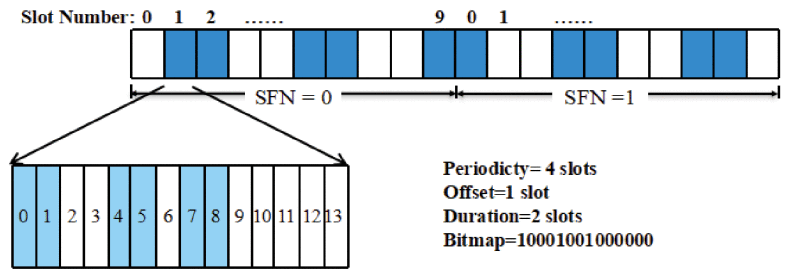
The System Frame Numbers (SFN) illustrated in Figure 1 carry the guidelines for PDCCH monitoring. The monitoring occurs during two slots, determined by the “Duration” parameter. It is delayed by one slot, and the pattern repeats every four slots, as dictated by the “Offset” and “Periodicity” parameters.
What constitutes the complete DRX cycle in LTE applications?
Figure 2 depicts the DRX mechanism in LTE/5G networks, showcasing how a device alternates between active and sleep states to conserve power while staying connected.
During the initial stage, the device wakes up to check for control information from the network, represented as PDCCH reception. At this juncture, the DRX timers, drx-InactivityTimer, and drx-onDurationTimer, come into play. The drx-InactivityTimer maintains the device active for a specific duration post data reception. The drx-onDurationTimer specifies how long the device remains awake during a DRX cycle to monitor downlink transmissions.
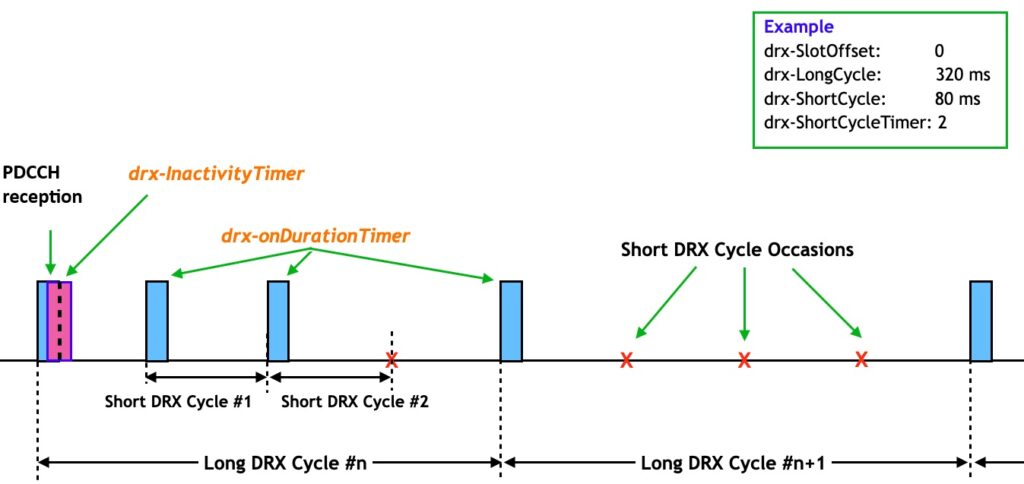
Once the inactivity timer elapses, the device enters a short DRX cycle with more frequent wake-up intervals. The Short DRX Cycle Occasions indicate when the device briefly wakes up to check for data. The short cycle duration is defined (e.g., 80 ms) and occurs for a set number of cycles (drx-ShortCycleTimer = 2).
If no data is received during a short DRX, the device transitions to a Long DRX Cycle, where wake-up intervals are longer (e.g., 320 ms), further reducing power consumption.
State diagram representation of DRX cycles in radio resource control
Figure 3 showcases a state diagram of a cellular network’s Radio Resource Control (RRC) states, demonstrating how a device shifts between various power consumption states. The state diagram’s main elements are categorized into RRC Idle, RRC Connected, and arrows indicating transitions.
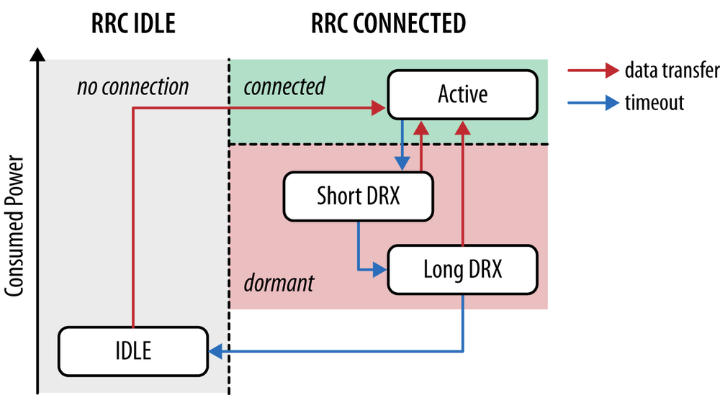
Figure 3. RRC State Diagram: Transitions Between IDLE, DRX, and Active Modes. (Image: Kevin Sookocheff)
RRC IDLE (left section):
- The device is disconnected from the network and consumes minimal power.
- Upon data transfer, it transitions to an Active state (red arrow).
- If there’s no activity for a specific duration, it remains in the IDLE state.
RRC CONNECTED (right section):
- The device is linked to the network.
- It can be in:
- Active state: high power consumption, utilized for data transfer.
- Short DRX: lower power consumption with short sleep cycles.
- Long DRX: even lower power usage with extended sleep cycles.
- The transition between these states occurs based on network activity and timeouts.
Arrows indicating transitions:
- Red arrows (Data Transfer): Move from lower to higher power states.
- Blue arrows (Timeout): Move from higher to lower power states.
Summary
Efficient PDCCH usage ensures effective communication of control information, facilitating optimal scheduling and resource allocation within the network. The integration of short and long DRX cycles strikes a balance between power conservation and latency. Short DRX cycles enable swift responses to incoming data, while long DRX cycles offer enhanced power savings during prolonged inactivity.
References
Power Consumption Modeling of Discontinuous Reception for Cellular Machine Type Communications, MDPI
Power Saving Techniques for 5G and Beyond, IEEE Access
5G NR: Connected Mode DRX, How LTE Stuff Works
How Does LTE Work?, Kevin Sookocheff
Related EE World Online Content
Power consumption for IoT modules: Protocols matter, 5G Technology World
Power sequencing — options and tradeoffs: part 2, Power Electronics Tips
Power sequencing — options and tradeoffs: part 1, Power Electronics Tips
IoT: How 5G differs from LTE, 5G Technology World