Imagine a world where machines not only maintain records but also think, learn, and adapt. This is no longer a work of fiction but the emerging reality of artificial intelligence (AI). Whether it’s voice assistants, self-driving cars, or other applications, AI technology is revolutionizing work, life, and connectivity.
Artificial intelligence (AI) refers to intelligent systems that mimic human intelligence to make decisions, solve problems, and learn. Over the past few decades, AI has become a crucial tool in almost every industry. With advancements in algorithms and access to vast datasets, the future of AI is poised to transform society in unprecedented ways.
This article delves into how the AI revolution will impact business, healthcare, ethics, and education. It’s essential to understand the potential and limitations of AI to shape a brighter, less biased future.
Learn AI and Machine Learning from the University of Texas at Austin
Enhance your career in AI by mastering Python, Deep Learning, NLP, Computer Vision, and Generative AI like ChatGPT in this AI course offered by the McCombs School of Business at The University of Texas at Austin.
A Brief History and Current State of AI
The roots of Artificial Intelligence trace back to the 1950s when pioneers like Alan Turing and John McCarthy laid the foundation. While early developments were limited by processing power, the 2000s saw a surge in AI progress with advanced algorithms and big data.
From basic narrow AIs that handled tasks like spam detection, we now have generative AI, such as ChatGPT, capable of content creation, coding, and artistic endeavors. Explore how generative AI is revolutionizing various industries.
Whether it’s voice assistants, autonomous vehicles, or targeted ads, AI has become an integral part of our daily lives, reshaping how we live and work. The line between machine and human intelligence continues to blur.
AI in Industry and the Economy
The impact of AI on industries and economies is transformative and disruptive.
- Automation and Labor Markets:
- AI-powered robots and software can execute routine tasks more efficiently than humans, boosting productivity but also displacing jobs in certain sectors.
- Manufacturing:
- AI enables predictive maintenance, real-time quality assurance, and streamlined supply chain operations.
- Logistics:
- Intelligent routing systems optimize delivery routes, while warehouse automation enhances efficiency.
- Finance:
- Agriculture:
- AI aids in crop monitoring, predictive yield analysis, and soil health assessment, with autonomous farming machines enhancing productivity.
AI Startups Driving Innovation
The rise of AI startups has spurred rapid innovation across sectors. Whether it’s diagnostics, fintech, or health tech, startups leveraging AI are disrupting traditional business models and exploring new frontiers. Learn how to master AI and be part of this wave of innovation.
AI Transformation in Legacy Industries
Legacy industries incorporating AI are gaining competitive advantages through streamlined workflows and data-driven decision-making. As we transition from a mechanized to an intelligent era, these firms are at the forefront of a new industrial revolution powered by smart systems.
AI in Everyday Life
The integration of artificial intelligence into daily life is becoming increasingly seamless. Smart assistants like Siri and Alexa handle scheduling, reminders, and real-time queries. We receive personalized recommendations for content, products, and navigation, while predictive algorithms anticipate our needs across various applications.
In Healthcare:
AI enhances diagnostics by analyzing medical images, predicts patient outcomes, and accelerates drug discovery. Virtual health assistants offer support for mental health and chronic condition management, providing round-the-clock care.
In Education:
AI-driven adaptive learning systems deliver personalized lessons tailored to individual student needs, bridging learning gaps. AI tutoring tools offer instant feedback, practice exercises, and personalized learning experiences.
AI is redefining convenience, accuracy, and personalization in our daily routines. As these systems become more intelligent and anticipatory, they collect more data, immersing us in a hyper-connected, AI-enhanced lifestyle.
Ethical Challenges and Risks
While AI offers immense potential, it also poses significant ethical dilemmas and risks. One major concern is algorithmic bias, where AI systems trained on biased datasets can perpetuate discrimination in areas like recruitment, policing, and lending.
To ensure fairness in AI, transparency in model design and accountability in outcomes are essential.
Data privacy is another critical issue, as AI heavily relies on personal information. Without robust security measures, user data can be misused or mishandled. The lack of standardized privacy protocols across borders further complicates the protection of individual rights.
AI automation has already displaced jobs in low-skill industries, potentially widening social inequalities. While new AI-related occupations are emerging, there is a growing need for extensive reskilling programs to mitigate economic disruptions.
More severe threats include autonomous weapons and the misuse of AI for spreading misinformation, including deepfakes. These pose risks not only to individuals but also to democratic systems and global stability.
Regulatory loopholes in sectors like surveillance and finance present opportunities for unchecked AI implementation. To ensure a safe and equitable future, collaboration among governments, corporations, and researchers is crucial to establish ethical frameworks, regulate AI effectively, and prioritize human-centric design.
The Future: What’s Next for AI?
Looking ahead, the future of AI evokes both excitement and uncertainty. A significant area of speculation is Artificial General Intelligence (AGI), which aims to match or surpass human cognitive abilities. While some experts predict the imminent emergence of AGI, others view it as a distant, possibly unattainable goal.
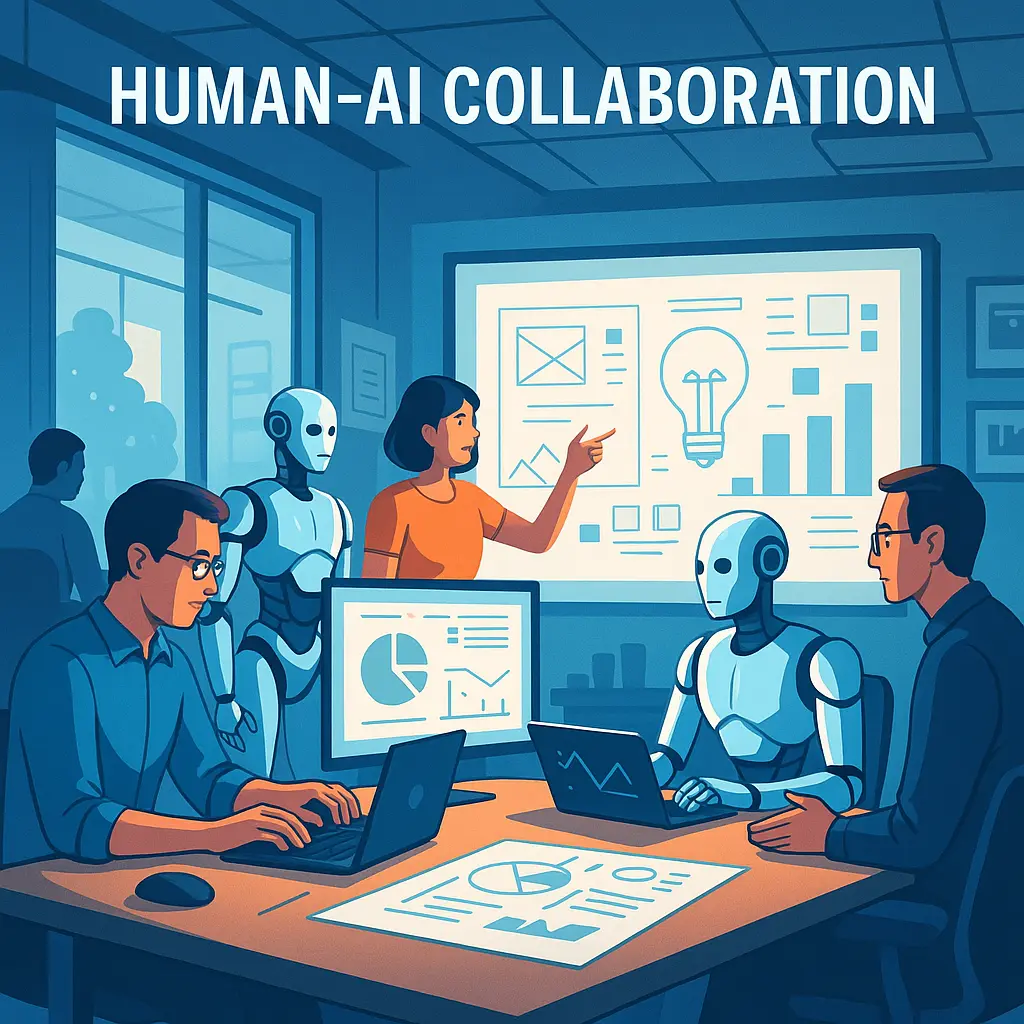
In the near term, human-AI collaboration holds immense promise. Rather than displacing humans, AI is poised to enhance our capabilities, aiding doctors in data analysis, empowering creatives in content creation, and supporting researchers in complex simulations. This co-evolution of human and machine intelligence could redefine productivity and innovation across all sectors.
Beyond industry-specific applications, AI has the potential to address global challenges. From optimizing energy systems to forecasting climate patterns, advancing medical research, and enhancing food distribution, AI could play a pivotal role in solving longstanding issues that traditional approaches have struggled to resolve.
However, realizing this future hinges on responsible innovation. As AI continues to evolve, collaboration between technologists, policymakers, and the public will be vital to ensure that its benefits are widely shared and its risks are mitigated. The next phase of AI development will be shaped not only by algorithms but also by the ethical principles we embed in them.
Artificial intelligence isn’t just a technological breakthrough; it’s a defining force of the 21st century. From its origins to the rise of generative AI, the technology has swiftly transitioned from labs into everyday life, reshaping industries, economies, and personal interactions.
As explored in this article, AI’s potential is vast, from enhancing healthcare and education to revolutionizing work dynamics and addressing global challenges. However, it also presents complex ethical and societal dilemmas that require thoughtful considerations.
The path forward isn’t merely about what AI can achieve but also about what it should strive for. As we embark on this new era, the decisions we make today regarding regulation, transparency, and inclusivity will define whether AI becomes a force for empowerment or division.
The future of AI is still unfolding. Let it be a narrative of innovative conscientiousness, where technology amplifies humanity rather than supplanting it.