Bitcoin ownership has seen a significant shift over the past year, with institutional players increasingly accumulating BTC. This trend has gained momentum since the approval of spot ETFs in January 2024. Conversely, many retail investors, driven by short-term gains or fear of volatility, are selling off their BTC holdings. Interestingly, they are selling to the very institutions that once doubted Bitcoin but now see it as a long-term store of value.
On-chain data indicates a rising institutional demand for BTC since the beginning of the second quarter. In contrast, retail investor demand for the token has plummeted since the start of the year, with a slight increase as the price reached a new ATH, followed by a decline. This suggests that institutions are driving the current BTC uptrend, with ETFs and corporate treasuries aggressively accumulating. The relative absence of retail traders could result in pent-up FOMO if the price breaks a range, leading to sharp volatility as new buyers enter the market, as well as an increased risk of local tops when sentiment spikes.
Therefore, retail traders are advised to monitor volume surges and spot demand, as several factors indicate a potential significant price action in the near future.
At $108K, BTC Price is Still Undervalued
The current Bitcoin price suggests room for growth, as indicated by the Mayer Multiple, an oscillator calculated by the ratio of price to the 200-day MA. A higher multiple implies that BTC is trading at a premium, but the current rates are lower, indicating that the token is undervalued.
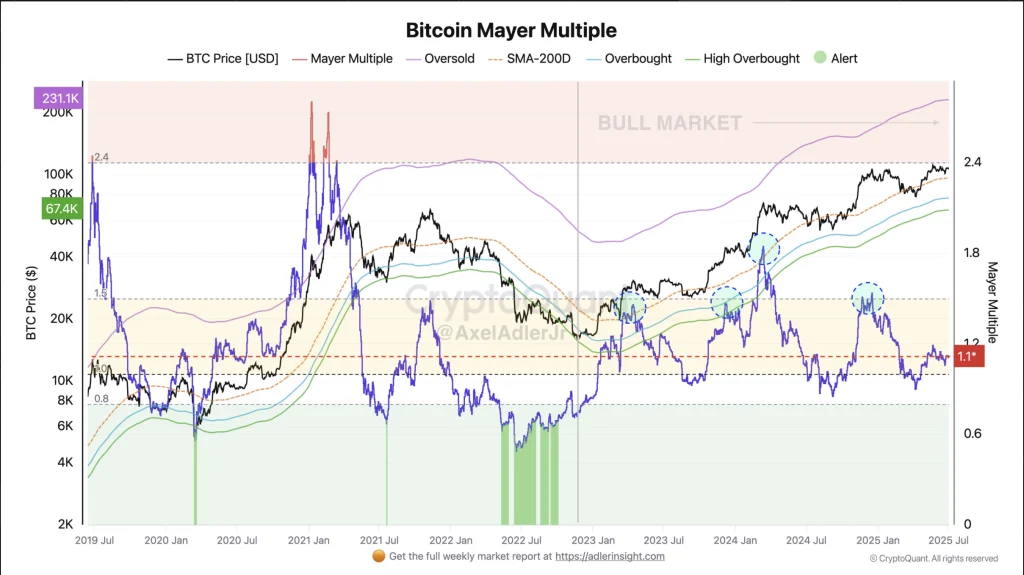
Bitcoin’s Mayer Multiple currently stands at 1.1x, just 10% above its 200 DMA and well below the 1.5x overheated zone. This indicates that Bitcoin is not overheated even as it approaches its ATH, suggesting that the token is still undervalued at $108K.
Another Dormant Whale Wakes Up
Recent days have witnessed the activation of dormant wallets after 14 years, with some transferred Bitcoin reportedly being sold. Despite this bearish pressure, the close consolidation of the BTC price indicates that bulls are still in control. A similar event occurred when Bitcoin experienced the third-largest single-day revival of old supply in history.
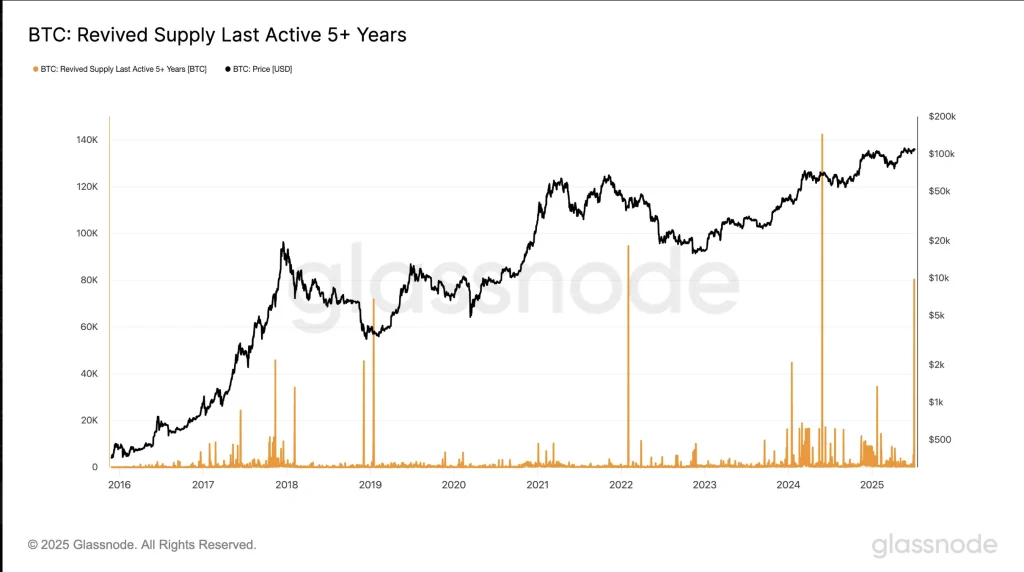
Data from Glassnode suggests that over 80,000 BTC inactive for over 5 years are on the move. While this transfer may have a significant impact given Bitcoin’s market cap exceeding $2 trillion, its short-term effect on price has been minimal. However, a potential supply shock could be looming.
Wrapping it Up!
In a landscape where institutions are actively accumulating Bitcoin, retail investors should consider the long-term implications of selling. Bitcoin’s value extends beyond its price, encompassing its decentralized, finite nature. By holding onto BTC, investors preserve their financial sovereignty and participate in a unique economic transformation. While selling may yield short-term profits, holding could position investors for exponential value growth as global adoption and institutional interest surge in the coming years.