Photonics integrated circuits (PICs) have the potential to revolutionize data transmission with their high-speed capabilities, low power consumption, and compact size, making them ideal for integration into edge devices. These circuits are increasingly being utilized in signal processing for edge AI and sensor applications.
Silicon photonics is a vast technology landscape that leverages CMOS processing, heterogeneous integration, and advanced optical functionality. Silicon-on-insulator (SOI) plays a pivotal role in enabling these advancements. Some key components of PICs include (Figure 1).
- Optical waveguides, crafted from silicon or silicon nitride, facilitate efficient on-chip optical connectivity.
- Optical ring resonators serve as fundamental building blocks, enabling the creation of optical filters, modulators, multiplexers, and frequency comb generators. Specialized designs like Fabry-Perot Resonators and Whispering Gallery Mode Resonators cater to specific functionalities.
- Modulators play a crucial role in managing photonics properties such as phase, polarization, and intensity to optimize PIC performance.
- Photodetectors establish connectivity between the optical and electrical segments of PICs and the external environment.
- Optical coupling elements are essential for combining, splitting, or redistributing optical signals. Grating couplers and edge couplers are popular choices due to their distinct advantages.

PICs in edge AI
PICs play a critical role in reducing latencies for applications like LIDAR in autonomous vehicles, enhancing safety in navigation. Additionally, the energy-efficient nature of PICs compared to conventional ICs is a significant advantage for energy-constrained edge devices.
Further energy savings are achievable through on-device data processing, minimizing reliance on cloud connectivity and associated energy demands. This approach also enhances the resilience of edge devices by reducing wireless connectivity requirements.
PICs in advanced sensors
PICs are instrumental in developing highly sensitive and compact sensors for edge applications. When combined with edge AI, PICs can facilitate real-time object and facial recognition, along with complex image processing functions, directly on the sensor chip.
PIC sensors are deployed in environmental monitoring for pollutant detection and quality measurement in air and water. They also find applications in food processing to analyze parameters like ripeness and nutrient content.
PIC lab on a chip
PIC sensors enable rapid diagnostics of medical and environmental conditions in the field, eliminating the need for remote laboratories. These sensors offer higher sensitivities and superior detection capabilities, with some models capable of detecting attomolar concentrations reliably.
Integrated optical sensors, typically using silicon nitride (SiN), provide excellent sensitivity across the visible to near-infrared range. Their small bend radius allows for long sensors to be compactly integrated on a PIC, maximizing sensitivity.
Certain sensor designs utilize coatings that alter their refractive index upon encountering target molecules. Photonic transducers capture these index changes, which are then transmitted via optical waveguides within the lab-on-a-chip setup (Figure 2).

Figure 2. Lab-on-a-chip biosensors, utilizing PICs, offer real-time medical diagnostic data. (Image: Aventier)
Other photonics platforms
PICs can extend beyond traditional materials like Si and SiN to incorporate silica (SiO2) for functions such as planar optical waveguides.
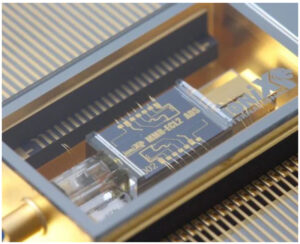
Figure 3. A tunable laser system showcasing hybrid integration with a low-loss SiN PIC and a high-performance InP PIC. (Image: PhotonDelta)
Lithium Niobate (LiNbO3) emerges as a material choice for low-loss modulators, thanks to its optical properties and broad transparency window. Lithium Niobate on Insulator (LNOI) technology is under development to enhance future PIC designs.
Hybrid integration of PIC technologies allows for optimized system cost and performance. For instance, a tunable laser system has been developed for military applications, merging a low-loss SiN PIC with a high-performance InP PIC (Figure 3).
Summary
PICs are finding increasing utility across a spectrum of edge applications, from data processing to sensor technologies. Their ability to reduce energy consumption, enhance processing capabilities, and support diverse integration approaches make them a key technology for the future.
References
References: SimuTech, Avantier, Light Science and Applications, Santec, APS Physics, AyarLabs, Ansys, PhotonDelta, AIM Photonics
EEWorld related content
Explore more: Single photon sensors in quantum computing, High-performance AI workloads with photonic chips, VCSEL vs. PCSEL, In-package optical interconnects for AI performance, UCIe on chiplets for data centers
Filed Under: AI/ML, FAQ, Featured