Ensuring compliance with personal protective equipment (PPE) in high-risk environments like manufacturing, logistics, and construction is crucial. Even a 1% non-compliance rate can have catastrophic consequences in terms of safety.
According to the U.S. Bureau of Labor Statistics, a significant number of workplace injuries occur because workers are not wearing the required PPE. Monitoring PPE usage is a major challenge, especially in dynamic work sites that operate 24/7.
It’s not just about helmets and vests; it’s about fostering a culture of consistent protection, even in situations where workers may be fatigued or rushing. Traditional manual audits are unable to detect issues in real-time like AI Vision can.
The challenge: invisibility of everyday risk
Traditional methods of PPE monitoring and enforcement rely on periodic audits, spot-checks by supervisors, and manual reporting after incidents. However, workers may temporarily remove helmets, and high-visibility vests can go unnoticed during night shifts. Violations are frequent, fleeting, and often go unseen in fast-paced operations.
This lack of visibility exposes companies to legal liability, insurance risks, a weakened safety culture, and inconsistent enforcement across shifts or sites.
What is needed is proactive and continuous PPE monitoring and awareness, not more paperwork.
The AI Vision solution: real-time compliance at scale
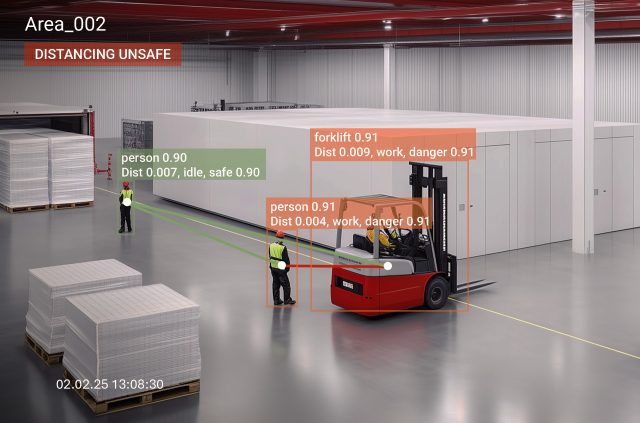
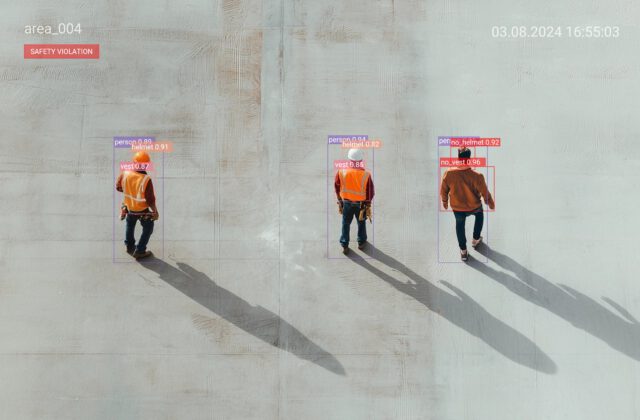
AI Vision revolutionizes PPE monitoring and enforcement by shifting from episodic to continuous monitoring. Smart cameras deployed at the edge can recognize the presence of required PPE and alert when it is not being worn.
Key features include:
- AI models trained to detect various PPE items.
- Site-specific detections configured for zone rules.
- Instant alerts triggered via lights, buzzers, or mobile devices.
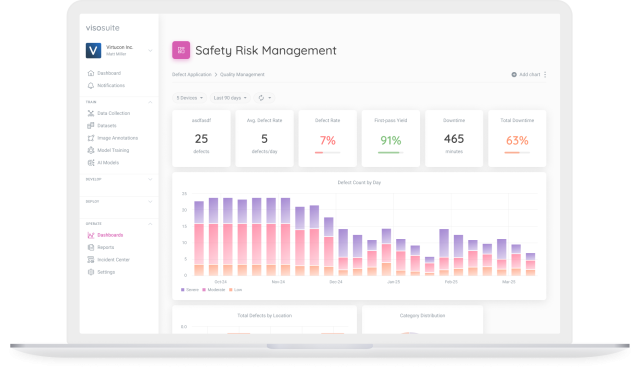
- Automatic data logging for reporting and compliance audits.
This approach enables consistent enforcement without human policing and transforms safety from a rule to a reflex.
Quick wins: three use cases driving results
1. Helmet detection at entry gates
AI Vision ensures that all personnel entering hazardous zones are wearing helmets. Missing PPE triggers audio alerts and may delay gate access.
Why it matters: 27% of head injuries in industrial settings occur within 10 minutes of entering the site.
2. Vest visibility in low-light or outdoor environments
AI models analyze contrast levels and material reflectivity to detect the presence of high-visibility gear, even in poor lighting conditions or at night.
Why it matters: Manual checks often fail when lighting conditions change, but AI Vision remains vigilant.
3. Custom PPE zone rules (e.g., gloves in fabrication, masks in paint bays)
AI Vision allows for the enforcement of site-specific PPE requirements by zone or task. Entering a fabrication cell without gloves, for example, triggers a localized alert.
Why it matters: It’s not just about what you wear, but where you wear it.
Business impact and ROI
Implementing AI Vision for PPE has resulted in significant improvements across industries:
- 98–99% compliance rates sustained over time.
- Fewer injuries and OSHA citations due to non-compliance.
- Accelerated new hire onboarding through visual reinforcement.
- Automated audit trails that reduce paperwork and investigator time.
Some facilities have reported a 30% decrease in injury-related downtime within the first quarter of deploying AI Vision.
Why traditional safety measures fall short
Manual PPE enforcement leads to gaps and fatigue, as supervisors cannot be everywhere at once. Peer enforcement can create tension, and non-compliance often becomes normalized when not monitored.
AI Vision addresses these challenges by providing:
- Consistent monitoring: across all zones, shifts, and workers.
- Timely alerts: in seconds, rather than days.
- Comprehensive documentation: for every event, ensuring readiness for reports.
Legacy systems focus on past audits, while AI Vision safeguards the present.
Addressing privacy and workforce concerns
Worker concerns about surveillance are addressed through AI Vision’s focus on PPE presence rather than individual identities. The system operates on-site, ensuring that no video leaves the premises. In unionized settings, co-designed alert thresholds and zone rules have built trust by emphasizing injury prevention over behavior monitoring.
What’s next: smart wearables and predictive safety
AI Vision is just the beginning, with emerging integrations that incorporate wearables, RFID tags for PPE validation, predictive models to identify at-risk zones based on historical data, and digital twin environments to simulate PPE risks in facility layouts.
PPE monitoring and compliance are evolving into intelligent, dynamic systems rather than static checklists.
Final thoughts: failure is not an option
Failure in PPE compliance is not an option when it comes to the well-being of workers and the integrity of the workplace. With AI Vision, companies can achieve exceptional compliance rates, creating a smarter and safer environment where safety is prioritized and enforced at all times.