Introduction
Since its inception in 2008, Bitcoin has been a game-changer in the world of finance, thanks to the revolutionary blockchain technology. The decentralized, anonymous, and transparent nature of Bitcoin and subsequent blockchains attracted investors worldwide. Operating as a data structure, blockchain relied on interconnected blocks containing crucial transaction information. Each block included a cryptographic hash of the previous block. For years, blockchain technology dominated the scene until the emergence of Directed Acyclic Graph (DAG) altered the landscape.
What is The Directed Acyclic Graph (DAG)?
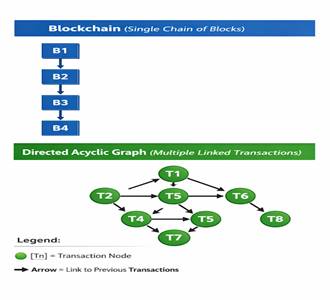
DAG, a data structure similar to blockchains, differs in its approach by forming a network of interconnected transactions rather than a single sequential chain. The concept first surfaced in 2016 when IOTA, a crypto project, implemented it for transactions. IOTA coined the term “tangle” to describe its transaction structure, likening it to a web of nodes housing transactions.
While a blockchain visually appears as a linear series of blocks, each linked solely to the previous one, a DAG structure resembles a network of dots interconnected in a manner that progresses forward without looping back to the origin. Each dot, or sphere, represents a vertex, while each line signifies an edge. The directed and acyclic nature of the edges ensures they only move in one direction without returning to their starting point. Refer to the image below for a visual representation of the model.
How the Structure Works
Understanding DAG entails some knowledge of blockchain technology, as DAG aims to enhance or replace it. In a blockchain system, blocks contain data from multiple transactions, grouped for efficiency. Miners or validators add and verify each block.
In contrast, DAG transactions stand independently, not bundled into blocks. This structure eliminates the need for miners or validators and operates non-sequentially compared to blockchain. Prior to adding a transaction, the user’s device performs a minimal validation to establish its authenticity. This validation serves to prevent spam, confirm earlier transactions, and maintain network security and order.
In a DAG structure, every new transaction must connect to an earlier unconfirmed transaction or reference the last confirmed one if all previous transactions are validated. This referencing of a previous unconfirmed transaction is termed a “tip.” When proposing a transaction, it links to a few previous tips, automatically confirming them upon reference. Your transaction will only be confirmed when someone builds on it.
Advantages of DAG Structure
No Delay
Unlike blockchains, DAG processes transactions instantly, provided you confirm previous unconfirmed transactions. Your wallet autonomously validates the transaction by tracing it back to the initial network transaction, minimizing the risk of validating an invalid transaction accidentally.
Scalability without Issues
Blockchains may encounter congestion, necessitating scalability solutions akin to adding extra lanes to a highway. In contrast, DAG seamlessly handles high transaction volumes without delays, obviating the need for scalability measures.
No Miners, No Validators, No Fees
DAG operates without traditional consensus mechanisms, eliminating the need for miners or validators and facilitating fee-free transactions. However, select nodes may levy a nominal fee to bolster network security.
Disadvantages of DAG
Centralization poses a potential threat to DAG’s progress, as certain corporate-run special nodes and coordinator nodes may wield disproportionate power. This centralized control heightens the risk of potential scams and attacks. Additionally, as a relatively newer technology compared to blockchain, DAG’s efficacy and resilience remain untested.
Bottom Line
While both blockchain and Directed Acyclic Graph technology aim to enable secure, decentralized transactions, they diverge in their operational methodologies. While blockchain enjoys wider adoption and maturity, DAG offers notable improvements in speed, scalability, and transaction costs. Despite concerns about centralization and its relatively shorter track record, DAG is poised to complement rather than supplant blockchain in 2026, with each technology catering to specific use cases based on their strengths.
Frequently Asked Questions
What sets DAG apart from blockchain technology?
Blockchains record transactions in sequential blocks, whereas DAG processes individual transactions in a web-like structure, enabling faster and more scalable validation.
Is DAG more scalable than blockchain?
Absolutely, DAG can handle higher transaction volumes without relying on block creation, averting congestion and scalability challenges.
Does DAG necessitate miners or validators?
No, DAG networks operate sans traditional miners or validators. Each new transaction aids in validating prior ones, ensuring network functionality.
Can DAG replace blockchain in the future?
While unlikely to fully supplant blockchain, DAG may complement it by powering applications requiring speed, low fees, and scalability.