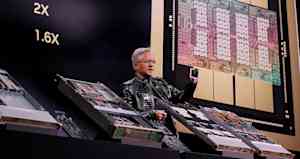
Nvidia Unveils Vera Rubin NVL72 at CES 2026
Nvidia’s latest innovation, the Vera Rubin NVL72, introduced at CES 2026, brings a new level of security to the tech industry. This groundbreaking platform encrypts every bus across 72 GPUs, 36 CPUs, and the entire NVLink fabric, marking a significant advancement in confidential computing. It is the first rack-scale solution that provides secure computing across CPU, GPU, and NVLink domains.
The introduction of Vera Rubin NVL72 has shifted the conversation for security leaders. Rather than relying on contractual trust with cloud providers to secure complex hybrid cloud configurations, they can now verify security measures cryptographically. This is crucial in a landscape where nation-state adversaries are capable of launching targeted cyberattacks at machine speed.
The Urgency of Securing AI
Research from Epoch AI indicates that the costs of training frontier AI models have been increasing at a rate of 2.4x annually since 2016. With billion-dollar training runs becoming a reality in the near future, the need for robust security measures is more pressing than ever. Unfortunately, existing security budgets are struggling to keep pace with the rapid evolution of model training, leaving many deployments vulnerable.
IBM’s 2025 Cost of Data Breach Report revealed that 13% of organizations have experienced breaches of AI models or applications, with 97% of those breached lacking proper AI access controls. Shadow AI incidents, which cost an average of $4.63 million, are becoming more prevalent, exposing sensitive data and intellectual property.
With organizations investing significant amounts in training AI models, the need for hardware-level encryption to protect these investments is paramount.
The Rise of Autonomous Cyberattacks
In a landmark disclosure in November 2025, Anthropic revealed that a Chinese state-sponsored group, GTG-1002, had orchestrated a large-scale cyberattack with minimal human intervention. This incident highlighted the increasing capabilities of adversaries to conduct autonomous intrusions at scale, posing a significant threat to cybersecurity.
Comparing the Performance of Blackwell vs. Rubin
| Specification | Blackwell GB300 NVL72 | Rubin NVL72 |
| Inference compute (FP4) | 1.44 exaFLOPS | 3.6 exaFLOPS |
| NVFP4 per GPU (inference) | 20 PFLOPS | 50 PFLOPS |
| Per-GPU NVLink bandwidth | 1.8 TB/s | 3.6 TB/s |
| Rack NVLink bandwidth | 130 TB/s | 260 TB/s |
| HBM bandwidth per GPU | ~8 TB/s | ~22 TB/s |
AMD’s Alternative Approach
While Nvidia leads the way in confidential computing, AMD offers an alternative with the Helios rack. Built on Meta’s Open Rack Wide specification, the Helios rack delivers approximately 2.9 exaflops of FP4 compute with 31 TB of HBM4 memory and 1.4 PB/s aggregate bandwidth. AMD prioritizes open standards through the Ultra Accelerator Link and Ultra Ethernet consortia, providing flexibility for security leaders to choose the best fit for their infrastructure.
The competition between Nvidia and AMD is giving security leaders more options to enhance their cybersecurity strategies.
Security Best Practices for the Future
Hardware-level confidentiality, combined with zero-trust principles, offers a robust security foundation for organizations running sensitive workloads. By verifying trust cryptographically, security leaders can ensure the integrity of their shared infrastructure.
Before deployment, it is essential to verify attestation and cryptographic compliance to prevent tampering. During operation, maintaining separate enclaves for training and inference, involving security teams from the start, and running joint exercises between security and data science teams are crucial steps to enhance security.
As the threat landscape evolves, the integration of hardware-level encryption and strong governance practices is essential for protecting high-value AI investments.
The question facing CISOs is not whether attested infrastructure is necessary but whether organizations can afford to operate without it in a world where cyber threats are increasingly sophisticated and automated.