Tokenized assets have long been touted as the future of finance, promising to revolutionize global markets. However, one major hurdle has stood in the way: settlement. Now, leading financial institutions like JPMorgan Chase & Co., Mastercard, and Ripple are throwing their weight behind technologies that could finally bridge this gap and bring trillions of dollars in real-world assets onto the blockchain.
The Challenge of Settlement in Tokenized Assets
For years, banks and asset managers have championed tokenization as the next big thing in finance. The concept is simple: convert traditional assets such as stocks, bonds, and real estate into digital tokens that can be traded instantly and around the clock.
However, the main roadblock has been settlement. While tokenized assets can move swiftly on a blockchain, the cash used for transactions still relies on legacy banking systems that operate within business hours and can take days to settle. This “settlement gap” has hindered the scaling of tokenized assets beyond pilot projects.
The inability to transfer both assets and funds simultaneously poses challenges such as counterparty risk, liquidity inefficiencies, and operational delays. Addressing this issue is crucial for tokenized markets to unlock the trillions of dollars currently tied up in traditional financial infrastructure.
The Breakthrough: A 5-Second Settlement Test Revolutionizing Transactions
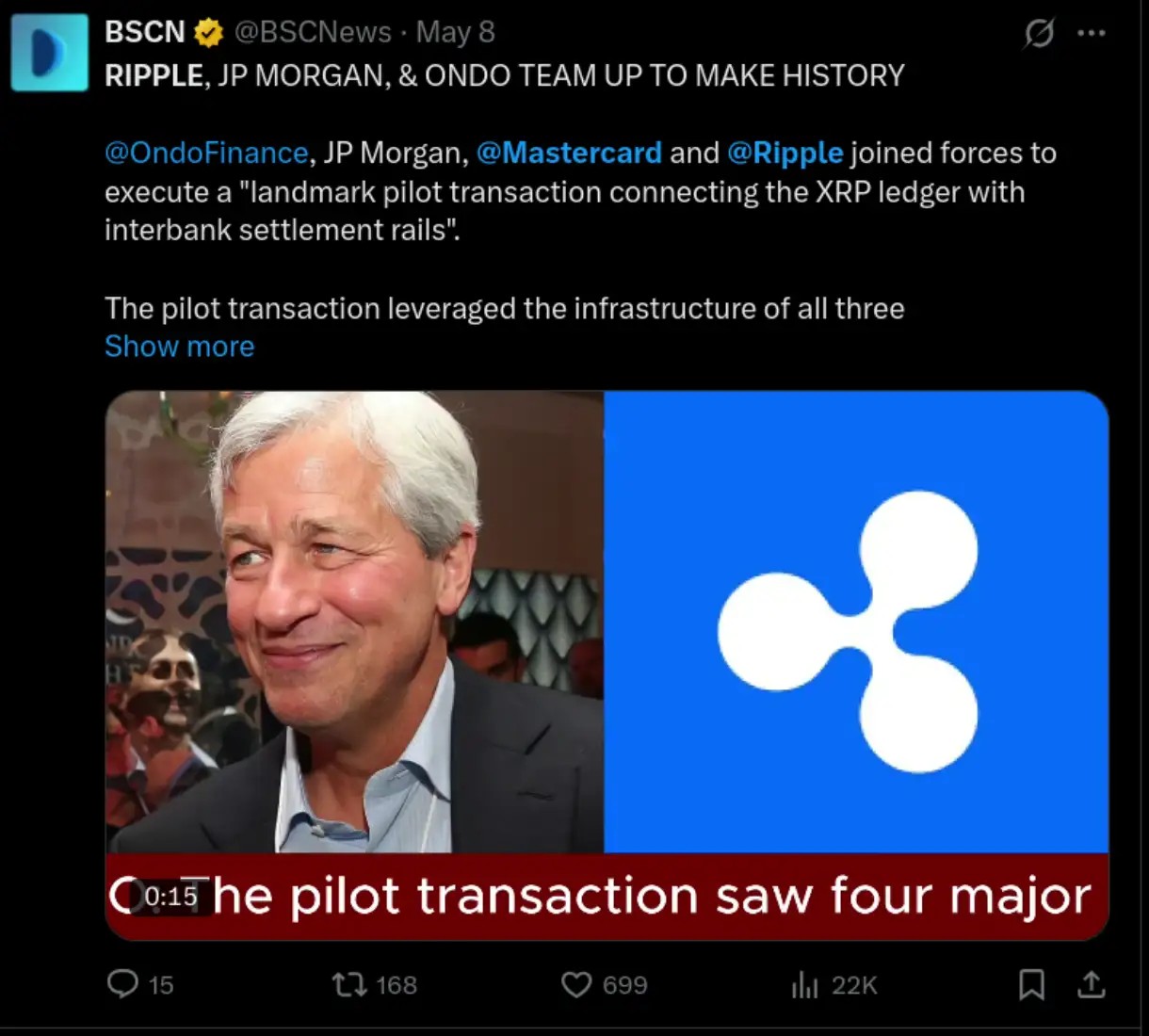
A significant milestone was reached when Ondo Finance, in partnership with JPMorgan Chase & Co.’s Kinexys platform, Mastercard, and Ripple, successfully executed what they described as the first near real-time, cross-border redemption of tokenized U.S. Treasuries across multiple banks. A process that typically takes days was completed in seconds, even outside regular banking hours.
Ripple redeemed a portion of its holdings in Ondo Finance’s OUSG tokenized Treasury fund on the XRP Ledger.
Mastercard’s Multi-Token Network transmitted settlement instructions to JPMorgan Chase’s Kinexys platform, which facilitated the transfer of U.S. dollar proceeds to Ripple’s account in Singapore through the traditional banking system.
The blockchain component was finalized in under five seconds, while the banking transfer was seamlessly integrated into the same workflow. The significance of this pilot lies in demonstrating that public blockchains and traditional banking infrastructure can collaborate in a single transaction flow.
This hybrid approach could pave the way for 24/7 settlement of tokenized assets, reducing delays, mitigating counterparty risk, and providing investors with quicker access to liquidity.
Benefits for Investors and Implications
If this model progresses beyond the pilot phase, it has the potential to revolutionize global settlement by replacing lengthy processes with near-instant transfers. The advantages for investors are substantial.
Almost immediate settlement reduces risks and enhances efficiency in capital utilization, freeing up funds for reinvestment at a faster pace.
Reducing intermediaries can lead to lower cross-border transaction costs, resulting in significant savings for large institutions.
Moreover, the pilot instills confidence in blockchain-based settlement and underscores the increasing institutional adoption of digital assets and fintech platforms focused on payments, liquidity, and financial infrastructure.
Key Takeaway
This development signifies a clear shift towards real-time global settlement, minimizing risks, cutting costs, and improving liquidity efficiency. It indicates growing institutional trust in blockchain-based payment infrastructure and a potential transformation in how global financial transactions are processed and valued.
Disclaimer:
This article provides information for educational purposes only and should not be construed as financial, investment, or trading advice. The opinions expressed are based on publicly available data, market observations, and the author’s interpretation at the time of writing. Cryptocurrency markets are highly volatile and unpredictable, and past performance or current technical setups do not guarantee future outcomes. Readers are advised to conduct their research and seek advice from a qualified financial advisor before making any investment decisions. TechGaged bears no responsibility for any losses incurred based on the information presented.