While initially deemed too costly for widespread deployment in mobile networks, mmWave technologies are finding application in various other scenarios.
With the incorporation of mmWave into cellular standards by 3GPP starting from Release 15, the first for 5G, the telecommunications industry hailed mmWave (24 GHz, 28 GHz, 39 GHz, and 52 GHz) as the future of mobile wireless. Operators boasted about incredibly fast download speeds, expecting consumers to embrace the technology. However, things took a different turn.
Despite the potential for mmWave channel bandwidths to reach up to 1 GHz, a significant improvement over LTE and even sub-6 GHz 5G, practical challenges and high deployment costs posed obstacles. The limited range, around 100 meters, and signal interference from obstacles like trees, buildings, and glass necessitated the installation of numerous small cells by carriers. While several companies introduced various repeater solutions for mmWave, the exorbitant expenses involved made it difficult for carriers to justify the investment. Some deployments did take place, predominantly in densely populated urban areas. Industry experts pronounced the demise of mmWave in mobile networks.
For those solely focused on mobile devices, it may seem like mmWave has faded into obscurity. In the realm of 6G discussions, there is minimal mention of mmWave aside from its potential role in Integrated Sensing and Communication (ISAC). Nonetheless, mmWave continues to thrive in commercial applications beyond radar and satellite technologies.
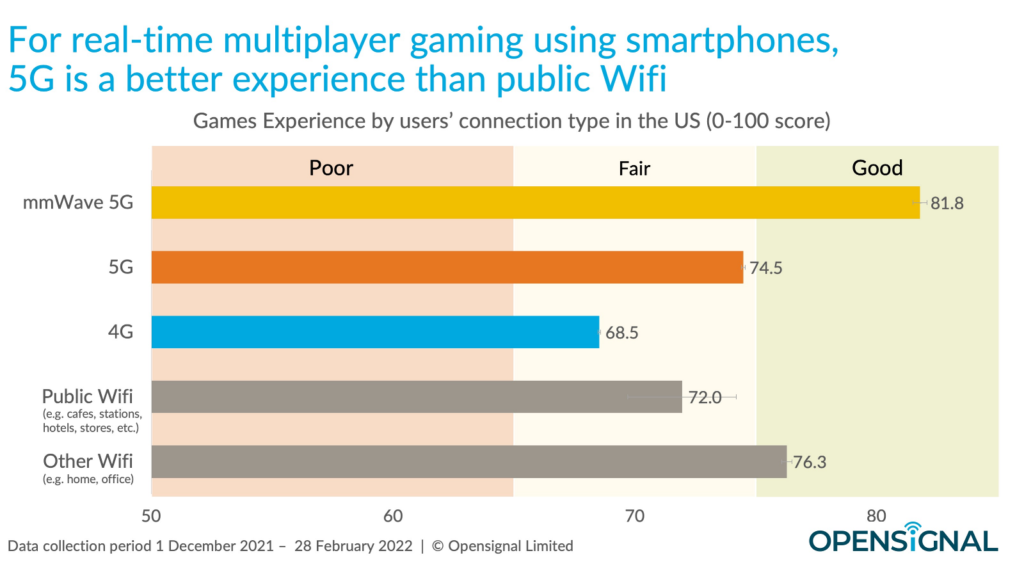
One notable area where mmWave has gained traction in the mobile sector is at stadiums and arenas where large numbers of users seek simultaneous connectivity, albeit with limited mobility. Figure 1 illustrates how multiple mmWave beams cater to users in a hockey arena. This setting exemplifies where mmWave signals offer tangible benefits for mobile usage. Not only can 5G mmWave accommodate numerous users, but it also provides lower latency compared to lower-frequency 5G signals.

No mobility
Fixed-wireless access (FWA) internet services have shown promise for mmWave signals. Many carriers across different countries employ mmWave for FWA. In the U.S., Verizon, AT&T, and T-Mobile, along with Canadian providers Rogers, Telus, and Bell, offer FWA using mmWave. While some deployments utilize mmWave exclusively, others incorporate sub-6 GHz connections as well.
Initially, FWA wireless links from a tower to a residence or business utilized 5G radios. However, this approach is evolving. Additionally, FWA is gaining traction in developing nations where equipment costs pose a significant hurdle.
“Various solutions are being developed to address FWA challenges,” stated Maryam Rofugaran from Movandi. “Many of these solutions combine millimeter wave front ends with Wi-Fi instead of relying solely on 5G. In India, FWA modems are leveraging 60 GHz carrier frequencies,” she added.
“There is a global interest in mmWave FWA,” remarked Pete Moosbrugger from Qorvo, “especially in developing nations, as it eliminates the need for extensive cabling.”
To enhance cost-efficiency for both base stations and user equipment, FWA radios are starting to integrate Orthogonal Frequency Division Multiple Access (OFDMA) modulation, similar to Wi-Fi 6 and subsequent versions. Figure 2 illustrates the OFDM structure with its symbols and subcarriers.

Aside from OFDMA integration, FWA radios leverage beamforming to cater to multiple users. Beamforming employs phased-array antennas to direct beams between a base station and a client. In mmWave communications, beamforming is particularly advantageous due to the short distances and signal attenuation, enhancing signal strength where needed.
“A phased array can generate a highly focused beam with a 10° beam width,” explained Moosbrugger. “With a phased array, energy can be precisely concentrated. At mmWave frequencies, the wavelength of individual antenna elements in a phased array is extremely small, fitting onto a 3-inch by 3-inch circuit board.”
As of 2025, EEWorld reported challenges faced by an FWA equipment manufacturer in sourcing components due to limited suppliers. This scenario is evolving, with companies like Qorvo and Movandi supplying beamformers, amplifiers, up/down converters, front-end modules, and other active components.
Beyond communications
While many commercial applications of mmWave focus on communication, the technology finds utility in various other sectors. For instance, mmWaves are utilized at airports for passenger screening purposes. A screening system from Rohde & Schwarz employs mmWaves to detect metallic and non-metallic objects carried by individuals.

Darren McCarthy detailed the use of mmWave in the scanner, employing non-ionizing multi-static radar where signals bounce off the skin rather than penetrating it. According to McCarthy, this mmWave scanner is safer than systems utilizing X-ray technology.
The scanner comprises 32 clusters with 94 transceivers on each side panel, totaling 3,008 transceivers operating across 160 frequencies ranging from 71 GHz to 81 GHz. McCarthy highlighted that the technology complies with federal safety standards and operates without moving parts. In this scenario, beamforming is unnecessary as both the signals and subjects remain stationary.
Similar to many applications of phased-array beamforming, the scanner can function even if not all transceivers are fully operational.
These applications of mmWave extend beyond traditional uses in radar, military, and satellites. Other applications include wireless backhaul, surveillance and video, and private networks.
Related EEWorld content
Lens antennas focus multiple wireless beams
OFDMA improves spectrum use in Wi-Fi 6
6G could add sensing to cellular networks
FWA equipment manufacturer contends with few mmWave suppliers
Filed Under: Communications, Featured