Enterprises benefit from dedicated network resources through network slicing, enabling the creation of private networks. This technology interacts with various network functions to achieve this.
The first part of this series delved into the capabilities of 5G network slicing in deploying, customizing, and scaling virtual networks. It also explored key slicing techniques, connectivity models, and how Single-Network Slice Selection Assistance Information (S-NSSAI), Network Repository Function (NRF), and UE slice assignment play crucial roles. Additionally, it discussed Packet Data Unit (PDU) sessions and network slicing configurations for roaming devices.
Enhancing Slice Selection with S-NSSAI
S-NSSAI manages service-specific resource allocation at the core network level in 5G network slicing. Collaboration between S-NSSAI and User Equipment Route Selection Policy (URSP) rules determines which 5G network slice a UE accesses, ensuring application-aware routing through the 5G core (5GC).
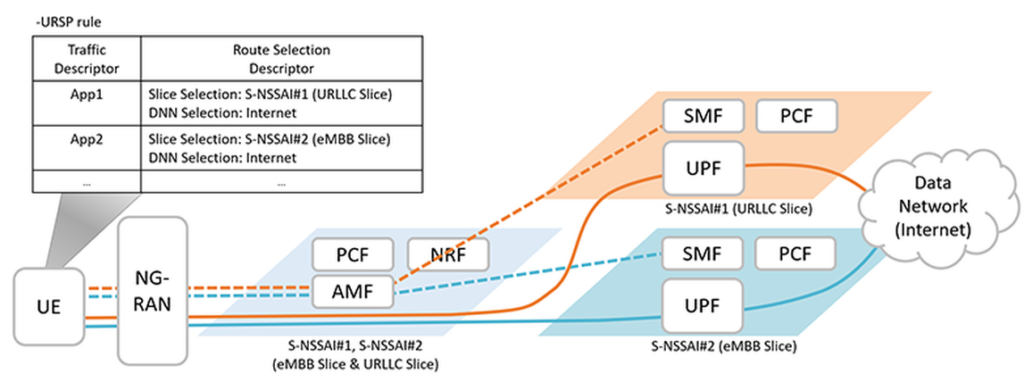
Figure 1. S-NSSAI, URSP rules, and Data Network Name (DNN) influence slice assignment and routing through the 5GC in a 5G network slice selection process. (Image: Samsung Research)
S-NSSAI consists of two components:
- Slice/Service Type (SST): an 8-bit field supporting up to 255 slice types, defining service categories like Enhanced Mobile Broadband (eMBB), Ultra-Reliable Low-Latency Communications (URLLC), and Massive Machine-Type Communications (mMTC).
- Slice Differentiator (SD): an optional value that differentiates slices of the same type, allowing for more precise selection and resource allocation.
The Network Slice Selection Assistance Information (NSSAI) protocol, in conjunction with S-NSSAI, serves as a service request list containing one or more S-NSSAIs, each representing a requested network slice. Meanwhile, URSP establishes routing policies based on slice selection, Data Network Name (DNN), access type, and application-specific criteria.
There are three primary types of NSSAIs:
- Subscribed S-NSSAI: Stored in the Unified Data Management (UDM) and selected as the default when the UE does not specify a requested NSSAI.
- Configured NSSAI: A PLMN-configured NSSAI capable of storing up to 16 S-NSSAIs in non-volatile memory (NVM), enabling persistent UE slice preferences.
- Allowed NSSAI: Determined by the Network Slice Selection Function (NSSF) based on operator policies and valid within a registration area.
When a UE transmits an NSSAI request, it specifies the target slices it wishes to access. The Access and Mobility Management Function (AMF) verifies the UE’s subscription and operator policies to ascertain available slices. Subsequently, the Network Slice Selection Function (NSSF) determines the allowed NSSAI, which the AMF uses to assign the UE to the designated slice.
Discovering Network Functions with NRF
Efficient service delivery necessitates the coordination of multiple network functions after a UE is assigned to a slice. The Network Repository Function (NRF) acts as a central directory, registering 5G network functions (NFs) such as AMF, Session Management Function (SMF), and User Plane Function (UPF), while overseeing availability and authorizing access. This function enables AMF, Network Slice Selection Function (NSSF), and SMF to dynamically retrieve and exchange data for slice assignment and resource allocation.
In Figure 2, NRF facilitates NF discovery and communication across the 5G core (5GC) through managing registration, policy control, and inter-NF interactions.

Figure 2. A 5G core architecture shows the NRF’s role in enabling efficient slice management and resource allocation. (Image: IPLook)
NRF automates network updates, supports real-time function changes, and verifies NF access before interactions. A crucial element of 5G network slicing, it enables dynamic resource allocation and performance optimization across multiple slices.
Assigning UEs to the Correct Slice
With network functions registered and accessible through NRF, the 5G core network allocates slices to UEs based on their service requirements. This process ensures that each UE receives the necessary resources for optimal performance.
Network slice selection typically follows these steps:
- UE registration: the UE sends a registration request containing its requested NSSAI, listing the network slices it wants to access.
- AMF and NSSF coordination: the AMF validates the UE’s subscription data against the subscribed S-NSSAI stored in the UDM. The NSSF then determines the correct slice based on the allowed NSSAI, the PLMN ID, and the configured NSSAI, which supports up to 16 S-NSSAIs per network.
- Slice assignment: the AMF assigns the UE to the appropriate slice. Notably, a UE can be served by up to eight S-NSSAIs per PLMN simultaneously.
Establishing PDU Sessions
Once a UE is assigned to a slice, the network establishes a PDU session to create a dedicated connection, triggered by the device’s session management request. In Figure 3, a PDU session manages multiple Quality of Service (QoS) flows between the UE, next-generation Node B (gNB), and user-plane function (UPF), ensuring efficient traffic handling across the network.

Figure 3. In this 5G PDU session architecture, QoS flows between the UE, gNB, and UPF, with data transmission managed through Data Radio Bearers (DRBs) over the air interface and GTP-U tunnels over the N3 interface. (Image: TechPlayOn)
The SMF handles:
- PDU session management: establishes, modifies, and terminates sessions.
- UPF selection and control: ensures optimal data routing and forwarding.
- IP address allocation and management: maintains seamless connectivity between the UE and external networks.
Each PDU session corresponds to a single S-NSSAI, ensuring service-specific network segmentation. However, a UE can simultaneously maintain multiple PDU sessions across different slices to support diverse application demands, such as utilizing an eMBB slice for high-speed video streaming while leveraging a URLLC slice for low-latency industrial control.
SMF selection depends on various factors, including S-NSSAI, which guarantees that the session is assigned to the correct network slice; Data Network Name (DNN), which directs traffic to the intended network service; and Tracking Area Identity (TAI), which preserves geographic service continuity.
Managing Network Slices for Roaming UEs
During roaming, a UE connects to a Visited PLMN (VPLMN) instead of its Home PLMN (HPLMN) but still requires access to its designated slice through S-NSSAI. Before assigning a slice, the VPLMN must validate the S-NSSAI against its configured values.
Depending on network capabilities, the requested slice may be assigned locally or necessitate support from the HPLMN. The VPLMN determines whether to use the HPLMN-provided S-NSSAI or map it to a local equivalent. Slice mapping occurs only if the VPLMN confirms that the mapped slice meets SLA-defined parameters, with the AMF providing mapping details during registration.
Roaming slice assignment generally follows these rules:
- VPLMN decision: If the visited network supports the requested slice, the UE will be assigned to a local equivalent.
- HPLMN fallback: If the VPLMN lacks the requested slice, the HPLMN may process the request remotely.
- Authentication and security: Certain S-NSSAIs require additional authentication and authorization. In such cases, the AMF in the VPLMN may trigger a Network Slice-Specific Authentication and Authorization (NSSAA) function in the HPLMN.
- UE Route Selection Policy (URSP): The HPLMN can provide a URSP through the H-PCF to assist with slice selection in roaming scenarios.
Standardized vs. Non-Standardized S-NSSAI in 5G Roaming
The ability to request and map slices across different networks hinges on whether the S-NSSAI adheres to standardized or operator-specific configurations. Standardized S-NSSAI utilizes 3GPP-defined SST values for global interoperability, enabling devices to request and access the same slice across networks.
Non-standardized S-NSSAI allows operators to define custom SST values for specialized services. While offering flexibility, custom slices remain operator-specific and lack global recognition.
Conclusion
5G network slicing leverages multiple protocols and network functions to facilitate service-specific resource allocation. S-NSSAI, URSP, and NSSAI determine the slice accessed by a UE, while NRF streamlines NF discovery, registration, and communication across the 5GC. PDU sessions manage QoS flows, ensuring efficient data transmission across slices. In roaming scenarios, slice mapping relies on VPLMN-HPLMN coordination, authentication, and URSP. Standardized and non-standardized S-NSSAI configurations further delineate slice interoperability across networks.
References
5G Technology: Network Slicing, Alali Khalaf
Network Slicing for 5G Success, Ericsson
Connectivity Meets Customization With 5G Network Slicing, CradlePoint
What Is 5G Network Slicing?, SDX Central
5G Future: Five Types of 5G Slicing, Fierce Network
What is Network Slicing and Why Does it Matter?, ElisaPolystar
Enhancing the Mobile Ecosystem with 5G Slicing, ServiceNow
Comprehensive Analysis of Network Slicing for the Developing Commercial Needs and Networking Challenges, ResearchGate
5G RAN and 5GC Network Slice Signaling, TechPlayOn
Network Slicing Security for 5G and 5G Advanced Systems, 3GPP
Network Slicing Concept, Motivation and Types, 5GHUB
Roaming in the 5G System: the 5GS Roaming Architecture, Ericsson