Precoding is a technique in signal processing that adjusts the phases and amplitudes of wireless signals to counteract channel distortion and optimize the quality and reliability of data transmissions. It plays a crucial role in supporting beamforming in multiple-input, multiple-output (MIMO) and massive MIMO antenna arrays.
This piece explores the advantages of precoding, delves into its implementation, briefly compares analog, linear, and non-linear precoding, and concludes with a look at hybrid precoding.
Some of the benefits of precoding include:
- Optimizing signals to compensate for channel impairments like interference and fading.
- Minimizing interference from neighboring signals.
- Directing energy towards the receiver to maximize effective signal strength.
- Enhancing the signal-to-noise ratio (SNR) and signal-to-interference-plus-noise ratio (SINR) to improve quality of service (QoS) and reliability.
- Maximizing channel capacity and sum-rate performance of MIMO and massive MIMO antenna systems.
- Adapting to channel conditions, sometimes utilizing real-time channel state information (CSI) to maintain optimal performance.
Process of Precoding
The precoding process commences with CSI estimations. CSI is obtained by transmitting training sequences or pilot signals from the receiver to the transmitter (Figure 1).
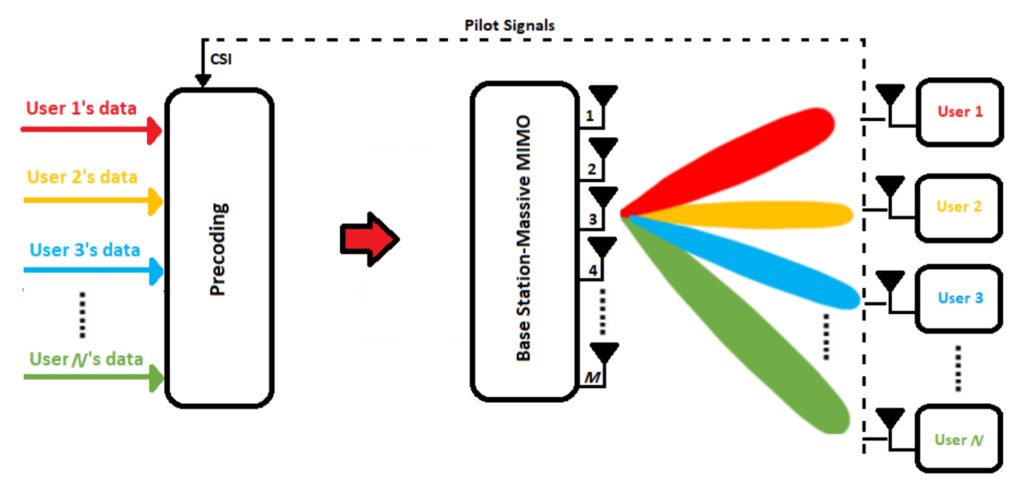
Figure 1. Massive MIMO system with N users and M antennas showing the flow of the pilot signals to the precoding function. (Image: IEEE Access)
Subsequently, the CSI estimates are utilized to calculate the precoding matrix. Various techniques are employed for precoding, including analog, linear, non-linear, and hybrid, each with trade-offs in terms of performance, cost, and complexity.
The precoding matrix is then used to generate the precoded signal necessary for beamforming and data transmission. At the receiver end, the process is reversed, and the precoding matrix is utilized to recover the original data symbols.
Analog, Linear, or Non-linear?
Precoding can be executed using analog or digital methods, with digital techniques further categorized into linear and non-linear approaches.
In analog precoding, adjustable phase shifters are employed to manage the phase of the signal at each antenna element, shaping the required radiation pattern. Analog precoding is simpler and more cost-effective than digital precoding, albeit less flexible.
Linear digital precoding is the next level of complexity. Linear precoding involves a linear transformation between the transmitted signal and the received signal, making it computationally efficient. Examples of linear precoding include:
Maximum Ratio Transmission (MRT): MRT precoding leverages the spatial diversity of the channel to maximize received signal power. It is commonly utilized in noise-limited environments but does not address inter-user interference, which can significantly impact performance in environments with multiple active users and high interference levels.
Zero-Forcing (ZF) is designed to eliminate inter-user interference by structuring the precoding matrix to eradicate interference at the receiver. While this technique effectively removes interference, it may also lead to noise amplification, adversely affecting system performance.
Non-linear digital precoding can enhance data rates and channel capacity but at the expense of increased complexity. Unlike linear precoding, which involves simple matrix multiplication, non-linear precoding may incorporate iterative algorithms or complex mathematical functions to optimize signal transmission based on specific channel information.
Dirty Paper Coding (DPC) is a prevalent example of non-linear precoding. To implement DPC, the transmitter must possess complete knowledge of the interfering signal to eliminate interference before encoding the data, presenting the receiver with an interference-free signal.
Hybrid Precoding
Hybrid precoding integrates analog and digital techniques, particularly valuable in massive MIMO systems requiring numerous antennas to form narrow beams. However, the high cost and power consumption of multiple RF chains render fully digital precoding impractical. In a standard setup, digital precoding precedes analog processing (Figure 2):
- A linear digital precoder employs CSI to eliminate interference and optimize power allocation.
- The analog precoder shapes the beam pattern using phase shifters.

Conclusion
Precoding is a vital operation in 5G communication systems, enhancing channel capacity, reducing power consumption, and improving QoS. Depending on specific cost and performance requirements, it can be implemented using analog, digital, or hybrid techniques.
References
Hybrid Precoding Algorithm for Millimeter-Wave Massive MIMO-NOMA Systems, MDPI electronics
Introduction to Hybrid Beamforming, MathWorks
Machine Learning-Inspired Hybrid Precoding for mmWave MU-MIMO Systems, MDPI sensors
Overview of Precoding Techniques for Massive MIMO, IEEE Access
Precoding, Wikipedia
Precoding, an overview, ScienceDirect
Understanding Precoding, Huawei
Related Content from EEWorld Online
Wi-Fi 7 and private 5G networks: co-existence or competition?
What are 5G’s, the different types, and how are they used?
The challenges of building a 5G base station
Creating 5G massive MIMO: Part 1
Choose a 5G base station’s PA bias control circuit