The majority of optical fibers utilize silica (SiO2) glass as their core material, although specialized applications may use other types of glass. The five main types of glass used in optical fibers are silica glass, germanosilicate glass, borosilicate glass, chalcogenide glass, and fluoride glass.
This article delves into the performance of various fiber optic glass materials in comparison to silica as the base material, and also explores the efforts to develop high-performance fluoride glass fibers in zero-gravity conditions on the International Space Station (ISS).
Key parameters affecting fiber performance include attenuation, wavelength, and dispersion (Figure 1). Performance characteristics can vary significantly across the different types of glass.
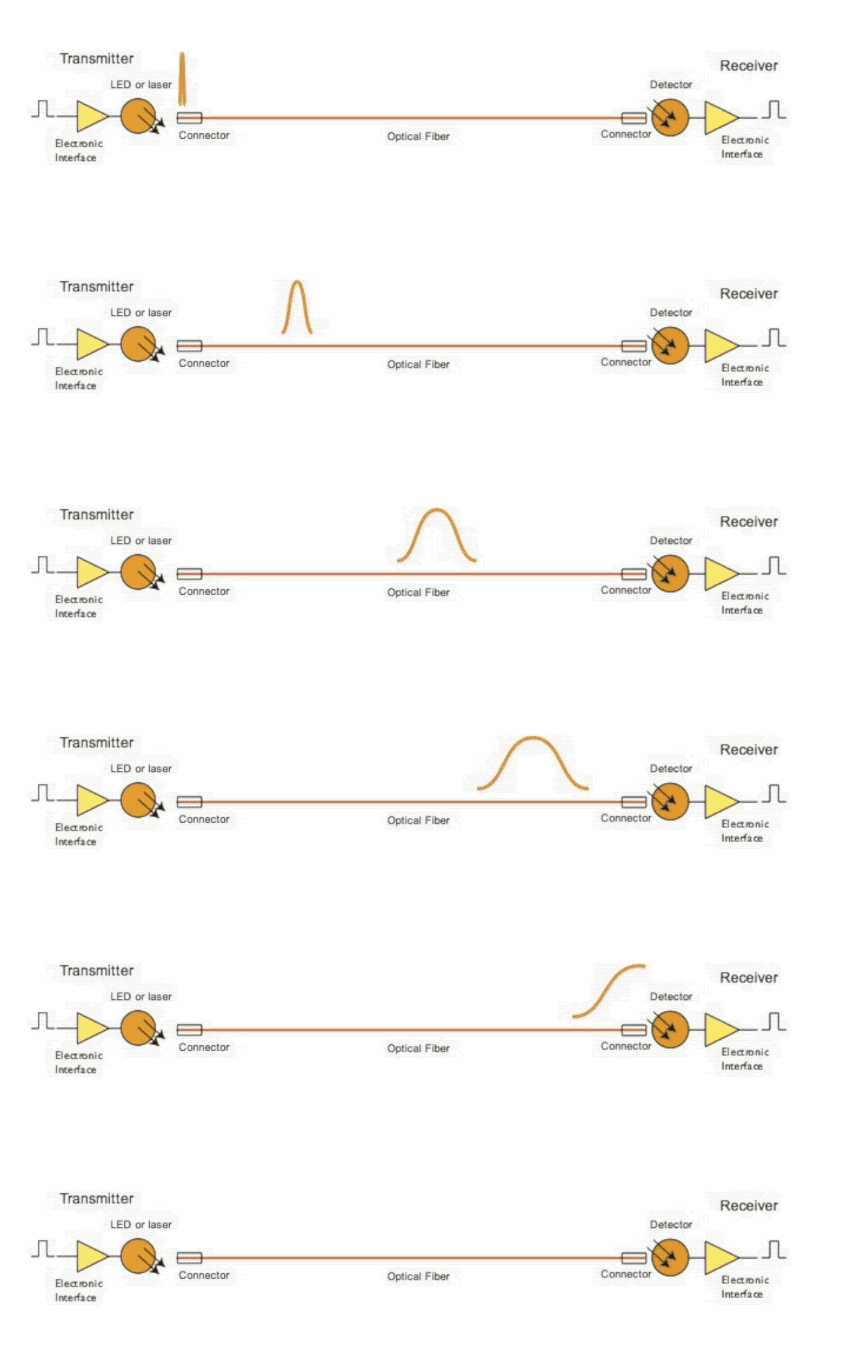
Figure 1. Dispersion refers to the broadening of a pulse as it travels through an optical fiber, which limits the bandwidth. (Image: Fiber Optic Association)
Silica and Germanosilicate Glass
Silica is the most commonly used glass in fiber optics, with germanosilicate being a mixture of silica and germanium dioxide (GeO2). Silica demonstrates excellent performance in the visible and near-infrared spectrum and is relatively simple to manufacture. However, its absorption levels significantly increase at longer wavelengths.
Adding a small percentage of GeO2 to silica produces germanosilicate glass, which enhances the refractive index and enables control over dispersion and other properties. For instance, while silica’s infrared transmission typically extends to around 2 μm, germanosilicate glass can effectively transmit up to 3 μm or higher, depending on the composition.
Borosilicate Glass
Doping silica with boron trioxide (B2O3), sometimes in conjunction with compounds like sodium oxide (Na2O) or aluminum oxide (Al2O3), results in borosilicate glass. Borosilicate fibers are more cost-effective compared to silica and are preferred for applications where cost, ease of processing, and resistance to thermal shock are crucial.
Chalcogenide Glass
Chalcogenide glass exhibits significantly lower attenuation in the mid-IR range than silica glass. For instance, they can have about 5 dB/m attenuation at a 10 µm wavelength, in contrast to silica’s attenuation of up to 60 dB/m for wavelengths beyond 3 µm.
Chalcogenide glass offers a broader transmission window, spanning from the visible to the mid-infrared region (0.5 to 25 µm), making it suitable for various infrared applications. The long-wavelength cutoff edge of chalcogenide glass depends on its formulation (Figure 2). The dispersion properties of chalcogenide glasses can be adjusted based on the specific formulation.

Figure 2. Photographs of three chalcogenide glasses (ChGs) using sulfur (S), selenium (Se), and tellurium (Te) (top) and corresponding IR transmission spectra (bottom). (Image: Advances in Optics and Photonics)
Fluoride Glass
Fluoride fibers, particularly ZBLAN (Zirconium-Barium-Lanthanum-Aluminum-Sodium), a common type of fluorozirconate glass, offer lower theoretical losses compared to silica and are well-suited for mid-infrared applications. Key performance parameters include:
- Reduced attenuation in the mid-IR range compared to silica fibers. ZBLAN can theoretically exhibit 10 to 100 times lower losses.
- Transparency across broader spectral ranges, such as 285 nm to 4.5 µm or 310 nm to 5.5 µm, extending ZBLAN’s operating range from visible to mid-infrared spectrum.
- Lower chromatic dispersion in comparison to other mid-IR transmitting fibers.
The performance of ZBLAN is heavily influenced by imperfections that occur during production, with high-quality ZBLAN being particularly challenging to manufacture.
ZBLAN and Microgravity
Based on estimates of the theoretical loss limit of ZBLAN, a 2,000-km length of ZBLAN fiber could have equivalent optical loss to 10 km of silica fiber. Unfortunately, imperfections arise in ZBLAN production on Earth due to convection and other gravity-induced phenomena, leading to the formation of microcrystals that render the fibers unsuitable for many commercial applications.
To circumvent gravity-related issues, ZBLAN is being experimentally produced in microgravity conditions aboard the ISS. These experiments could pave the way for large-scale commercial production of high-performance ZBLAN in low Earth orbit (Figure 3).

Figure 3. This was made in the Space FOMS Space Facility for Orbital Remote Manufacturing (SpaceFORM) experiment in the ISS, which can make up to 50 km of ZBLAN optical fiber in a single flight. (Image: NASA)
Summary
Silica glass fibers provide a balanced cost/performance ratio for most applications. Germanosilicate glass, produced by adding GeO2 to silica, is the second most commonly used material in optical fibers, offering performance tuning over basic silica. Borosilicate glass serves as a cost-effective alternative, while chalcogenide and fluoride glasses are preferred for high-performance requirements.
References
Chalcogenide Glass Fibers, Coractive
Exotic Glass Fibers From Space: The Race to Manufacture ZBLAN, ISS National Laboratory
Fluoride glass optical fiber, Thorlabs
Infrared Fibers, Advances in Optics and Photonics
Myths and legends about glass: from the core of an optical fiber, Pyrois Tech
Optical glasses, RP Photonics Encyclopedia
The FOA Reference Guide To Fiber Optics, Fiber Optic Association
Types of Optical Fibers: What You Need to Know, HFCL
EEWorld related content
Where do fiber optics fit into automotive wiring harnesses?
What are the fiber options for 5G fronthaul?
What embedded protocols can you use for optical connectivity?
How can in-package optical interconnects enhance chiplet generative AI performance?
Why use attenuators in quantum computers?
Filed Under: FAQ, Featured