The IEEE 5G/6G Innovation Testbed replicates an entire network from the radio to the core, allowing engineers to test 5G hardware and software at any point in the network. EE World had the opportunity to visit IEEE in June 2025 for a meeting and demonstration, as shown in the video below.
If you are designing IoT devices to connect to a 5G network, testing your device’s compatibility with a network is essential. Whether you are developing small-cell radios, xApps for Open RAN networks, network components, or 5G core network software, testing your product in a simulated network environment before connecting to a live network is crucial. Instead of hiring a test lab or investing in expensive test equipment, consider using the IEEE 5G/6G Innovation Testbed.
Led by IEEE member/volunteers Ashutosh Dutta and Anwer Al-Dulaimi, IEEE has developed a cloud-based digital twin of a complete 5G network, mostly open-source. Users can access the tool for testing hardware or software across the network, from the radio to the core. Think of the testbed as a hardware or software in the loop for telecom. During the visit to the IEEE Operations Center in Piscataway, NJ on June 2, 2025, EE World met with testbed program director Brad Kloza and product manager Naresh Babu, who oversee the testbed operations with guidance from the testbed’s steering committee.
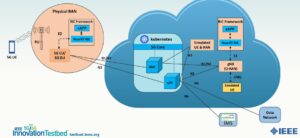
Figure 1. The IEEE 5G/6G Innovation Testbed is a cloud-based system of mostly open-source software that emulates a network. Users can insert their hardware or software network components anywhere in the network for testing.
Figure 1 showcases a diagram of the 5G/6G Innovation Testbed, comprising software components that simulate a complete network. Being cloud-based, the testbed offers accessibility from anywhere. “It’s a fully virtual end-to-end 5G network in the cloud,” mentioned Kloza.
Each company or university subscribing to the testbed possesses a unique account containing a personalized version of the testbed software and cloud resources. With numerous open-source components, users have the flexibility to customize the testbed, such as developing their network slice or use case. These modifications are isolated within the user’s account without impacting others. “We clone the virtual network, we set it aside, and we assign it to each account,” explained Kloza. “Each account is administered by an administrator who can allocate logins to staff, faculty, or students as required. Companies or universities can upload algorithms into their testbed version to observe their interactions within the network.”
Kloza initiates each potential user interaction by inquiring, “What are you working on, and what are you looking to achieve in the testbed?” This approach enables IEEE to set up a unique instance of the testbed for each trial version.
Testbed capabilities
During the visit, the 5G/6G Innovation Testbed featured several capabilities, with more in development.
- Network Slicing
- Ran-intelligent controller (RIC) integration and xApps support
- Test orchestration
- Cloud orchestration
- CAMARA API support
- Closed-loop automation and lifecycle management
- Multi-cluster Orchestration
- Audio/video Calls
- Video streaming with multi-access edge computing (MEC) platform
- Data Plane Development Kit (DPDK)-based User-Plane Function (UPF) integration
- Integration of physical Open RAN
- Private 5G networks
- Metrics monitoring
- Energy metrics
- Traffic control
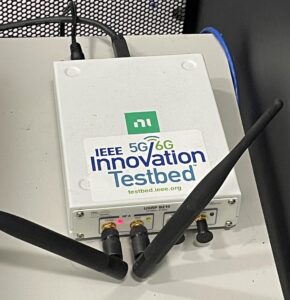
Figure 2. The testbed uses an NI software-defined radio as the air interface for testing 5G devices with radios.
Connecting wireless devices like cell phones or IoT devices to the testbed necessitates an air interface. Figure 2 depicts an NI USRP B210 Cognitive Radio. Additionally, Figure 3 displays two cell phones linked to the testbed.
Testbed components
Designing a virtual network entails integrating various network components. Figure 1 provides an overview of the primary components: user equipment, radio-access network (RAN), and the 5G core. The testbed supports Open RAN, enabling developers to test distributed units, centralized units, and xApps within the virtual network.
The 5G/6G Innovation Testbed incorporates a mix of open-source and proprietary software, including:
- Kubernetes open-source container orchestration software facilitating application deployment and management.
- CAMARA open-source software offering telecom APIs for seamless access to telco network capabilities, interacting directly with the 5G Core network.
- FlexRIC, open-source software enabling xApp testing and development in Open RAN.
- OBS Studio, open-source software aiding video streaming and recording.
- AMCOP from Aarna Networks, a proprietary multi-cluster orchestration and cloud management tool.
- Niksun NetMobility, a proprietary 5G network monitoring security tool.
- Grafana, open-source customizable metrics reporting dashboard.
- Open Speed Test, open-source network speed test software.
- Kamailio, open-source SIP server.
- srsRAN and OpenAirInterface, open-source Open RAN 5G cores.
- Scapy, open-source packet manipulation program and library.
- UERANSIM, open-source 5G UE and RAN (gNodeB) simulator.
- Open5GS, open-source 5G core.
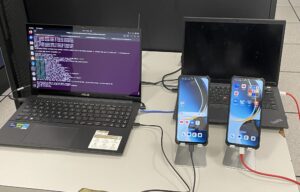
Figure 3. Two cellphones under test connect to the Testbed through the software-defined radio.
With an expanding set of tools, users can configure and execute various network scenarios and use cases directly, such as network slicing, denial-of-service attacks, quality of service modifications, and more,” noted Kloza.
Furthermore, IEEE offers the Test Bench in partnership with Rebaca Technologies of California, an additional environment providing a robust test orchestration environment with numerous pre-scripted test cases, particularly beneficial for companies focusing on core network functions and Open RAN software.
Demonstration video
The development engineers at the IEEE Testbed created a user interface that enables customization of testing and connection to the hardware or software under test. Given the predominance of open-source software in the testbed, engineers can tailor it to their needs. All intellectual property developed using the testbed belongs to the user.
Kloza detailed how the dashboard provides a real-time view of the virtual network, showcasing connected elements, operational status, user count, traffic flow, and more. The video presented examples of the user interface and use cases like network slicing, DDoS attack simulation and tracing, and a video streaming demonstration illustrating how interference affects video quality and how network APIs can address it. In a video recorded post EE World’s visit, Brad Kloza conducted a demonstration of the user interface and use cases.
Beyond testing
In addition to testing hardware and software interactions with a network, engineers, students, and researchers can use the IEEE 5G/6G Innovation Testbed to showcase and demonstrate IP to management, clients, or professors. Students can leverage the testbed as an educational tool to showcase their work.
The testbed supports multiple users or organizations operating within a single environment while ensuring privacy and security. “On the research front,” Kloza explained, “students can explore network optimizations or new functionalities. This is where students or student groups, along with faculty members, utilize the testbed to experiment with new technologies and publish their findings.”
Initially designed for testing