Tokenization has emerged as a popular term in the world of cryptocurrency, with Grayscale’s head of research Zach Pandl suggesting that investors view it as a long-term roadmap with varying winners at different stages, rather than a single trade.
Speaking at the EthCC conference in Cannes, France, Pandl noted that tokenized assets, which involve utilizing blockchain technology to settle, transfer, and record ownership of various financial assets like bonds, funds, and equities, are experiencing rapid growth. Despite this growth, the current market size of $27 billion represents only a minuscule fraction (0.01%) of global capital markets. However, projections indicate that this figure could soar to nearly $19 trillion by 2033, according to BCG and Ripple.
Major banks and asset managers are already recognizing the potential of stablecoins and tokenization. However, they are still determining the best strategies to capitalize on these innovations.
Pandl anticipates that tokenization will progress in stages, with different networks and models capturing value at each phase.
He believes that initial winners in this process may resemble traditional financial structures, rather than deviating from them.
\”In the early stages of tokenization, we are likely to see success in projects that mirror the current financial system,\” he explained.
This could involve institution-centric, permissioned systems that address practical concerns like privacy, identity, and control.
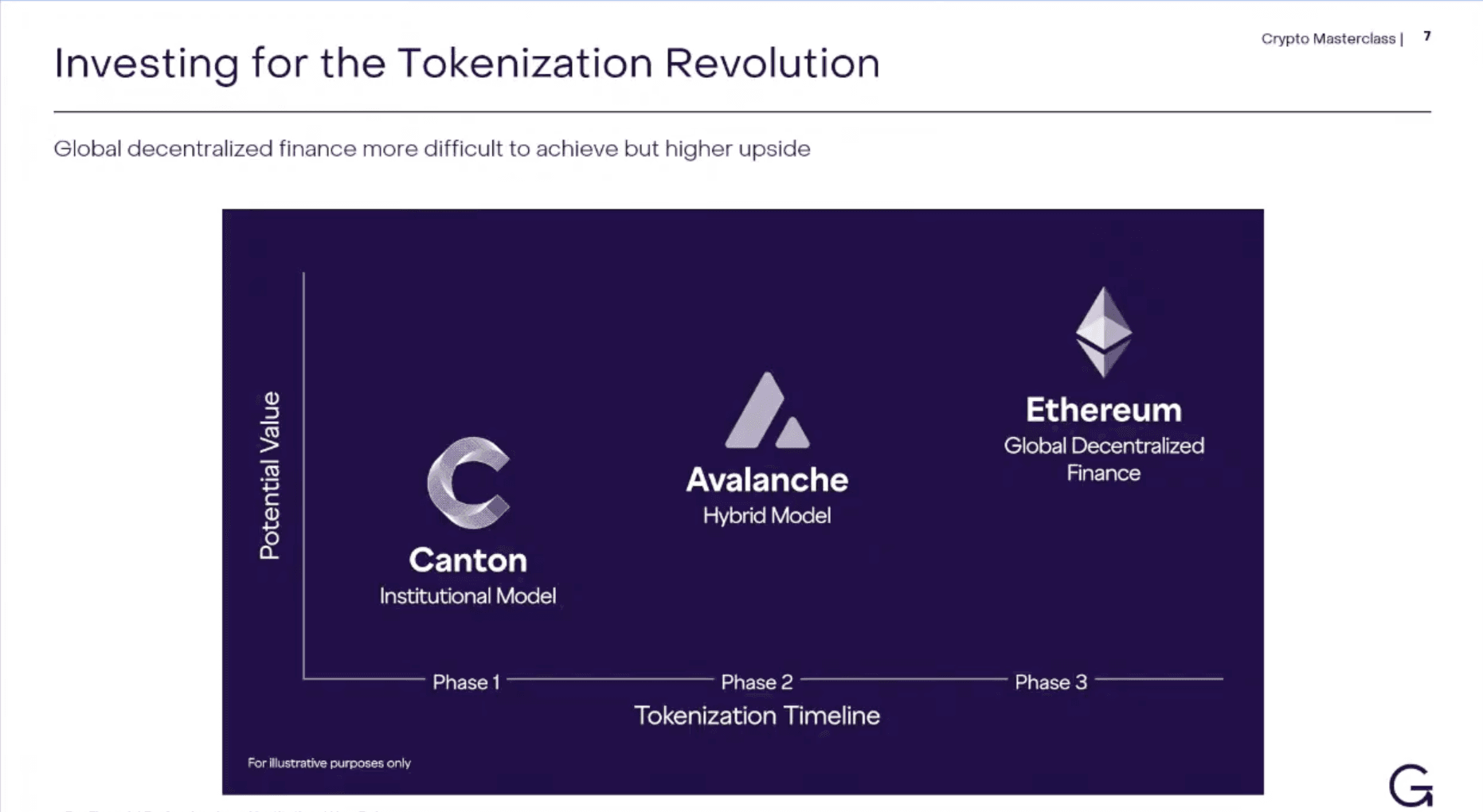
Pandl highlighted the Canton Network (CC), supported by major Wall Street players such as DRW, TradeWeb, Goldman Sachs, and Nasdaq, as a potential frontrunner in the initial phase of tokenization.
He suggested that investing in this network could offer near-term traction, even though Canton’s approach closely resembles the current financial system with slight enhancements.
The second phase
The next phase of tokenization might involve a hybrid model incorporating both institution-owned blockchains and a globally shared state, with interconnected networks communicating with one another. Avalanche (AVAX) is cited as an example, featuring numerous sovereign and corporate-owned chains (subnets) linked to a primary layer-1 network.
Pandl views Ethereum’s ether ($ETH) as a significant yet slower investment. While he envisions a shift towards “global decentralized finance” in the future, he acknowledges that the technology and institutions are not fully prepared for this transition.
Therefore, investing in $ETH may appeal to those willing to wait for a shift away from financial intermediaries in the long term.
Additionally, Pandl emphasized the potential of chain-agnostic service providers like Chainlink as lucrative opportunities, possibly more compelling than certain blockchains.
Read more: How tokenized assets could become a $400 billion market in 2026