
The discourse surrounding automation has shifted from the debate on whether AI algorithms will surpass human workers to the question of how professionals who incorporate these systems will outperform those who resist. If you’ve been pondering whether AI will displace jobs, the likelihood is that it will.
Data suggests that 69% of professionals believe that their work is being influenced by technology, particularly AI. Nonetheless, this disruption presents significant opportunities, with 78% of workers expressing optimism about the potential impact of AI on their careers.
Professionals who harness AI, large language models (LLMs), and predictive analytics are enhancing their skills to integrate automation into their workflows for long-term success.
Understanding the evolution of Careers & Jobs in Artificial Intelligence (AI) is crucial for anyone looking to safeguard their livelihood. Refusing to embrace these cognitive tools is no longer a passive stance; it is a deliberate hindrance to your career progression.
Key Impacts on Career Growth in 2026
The professional consequence of not adopting AI is no longer theoretical. Executives surveyed across various industries have been clear: neglecting AI poses a greater career risk than AI itself. This impact is evident across four critical dimensions.
1. Passed Over for Promotions
Current promotion decisions increasingly reflect an employee’s capacity to use emerging technologies to drive results. Managers are starting to view AI proficiency, or the lack thereof, as an indicator of adaptability and strategic thinking.
Employees who rely solely on manual processes are often seen as working harder, not smarter. In performance appraisals, those who showcase AI-enhanced productivity are more likely to be identified as high-potential contributors.
According to the Great Learning Upskilling Trends Report, 15% of professionals identify promotions as a primary motivation for upskilling, underscoring the direct link between the two in professional perception.
2. Job Insecurity
The refusal to adopt AI not only hinders career growth but can expedite job displacement. Industry research indicates that executives are increasingly considering AI readiness in workforce decisions.
Professionals who cannot demonstrate proficiency with AI tools are at a distinct disadvantage during restructuring processes or role redefinitions. The World Economic Forum’s Future of Jobs Report projects that approximately 92 million jobs will be displaced by technological advancements by 2030, many of which involve routine cognitive tasks that are now automated.
Professionals who delay upskilling are directly in the path of this disruption. For those navigating a career transition, resources like “How an AI Course Can Help You Pivot After a Layoff” offer structured guidance on repositioning oneself in an AI-driven market.
3. Stagnation vs. Productivity
The productivity gap between AI-enabled professionals and those operating without AI assistance is widening rapidly.
Tasks that previously took hours, such as drafting reports, synthesizing data, and creating presentations, are now completed in minutes by professionals proficient in generative AI (GenAI) tools.
According to the Upskilling Trend Report, 60% of professionals already use GenAI always or frequently in their work, and 80% use it to learn new skills. Those who opt out of this shift are not just maintaining a baseline; they are falling behind.
If you’re unsure about the current demands of AI, this video is a useful starting point: 6 Steps to Get Started with AI for Beginners.
4. Weak Competitive Positioning
In a job market where 43% of professionals cite high competition as a major challenge, the differentiator between comparable candidates is increasingly AI competency. Hiring managers are not just looking for domain expertise; they are seeking professionals who can enhance it with AI.
Candidates without demonstrable AI skills are entering an inherently uneven competitive landscape. To get started, you can explore what employers expect beyond basic knowledge in this insightful read: What Employers Expect Beyond Basic AI Tool Usage.
To counteract this stagnation, consider comprehensive upskilling pathways like the PG Program in Artificial Intelligence & Machine Learning.
This program, delivered in collaboration with leading academic institutions, covers core domains such as Machine Learning, Natural Language Processing, and Computer Vision. Designed for in-depth skill development, it offers a structured curriculum that bridges the gap between theoretical algorithms and strategic business applications, equipping you to adeptly navigate technological disruptions.
AI Adoption Is Not Just for Tech Roles
A common misconception is that AI fluency is a requirement only for software engineers, data scientists, or machine learning specialists.
This oversimplification is risky. AI serves as a cross-functional productivity layer; it is as relevant to a marketing manager as it is to a cloud architect. Here’s how:
- Marketing: Generative AI tools are revolutionizing content strategy, SEO, and audience segmentation. Marketers who utilize large language models (LLMs) for content creation, predictive analytics for campaign performance, and AI-driven A/B testing consistently outperform peers using traditional methods.
- HR: Human resources professionals are employing AI for intelligent candidate screening, sentiment analysis of employee feedback, and workforce demand forecasting. AI-driven hiring processes reduce time-to-hire and enhance candidate quality. Professionals interested in further exploring this shift can delve into Career Options in AI for diverse perspectives.
- Finance: From AI-driven revenue forecasting to automated anomaly detection in financial statements, finance professionals are leveraging machine learning models to add predictive intelligence to their analyses. Manual forecasting is being replaced by AI-powered decision support systems.
- Operations: AI-enabled workflow automation tools enable operations managers to identify bottlenecks, anticipate supply chain disruptions, and optimize resource allocation in real time. Those who comprehend how to design and manage these automated workflows possess a tangible strategic advantage.
If you’re curious about AI careers across these domains, watch: Careers & Jobs in Artificial Intelligence (AI).
Must-Have AI Skills to Stay Relevant
The following are the essential capabilities that professionals must develop to remain competitive. These are not just buzzwords; they are operational skills now indispensable across roles and industries.
1. Prompt Engineering
Prompt engineering is the art of structuring inputs to large language models (LLMs) to generate accurate, contextually relevant, and actionable outputs. It is the foundational skill of the AI era.
- Writing clear, context-rich, goal-oriented prompts that minimize errors and maximize accuracy
- Utilizing zero-shot, few-shot, and chain-of-thought prompting techniques based on task complexity
- Iterating on outputs through structured feedback loops to progressively refine AI-generated content
- Understanding token limits, temperature settings, and how model parameters impact output behavior
2. AI-Assisted Decision Making
This skill involves embedding AI-generated insights into strategic and operational decision-making processes.
- Using predictive analytics dashboards to interpret AI-generated forecasts and recommendations
- Identifying which decisions benefit from AI assistance versus those requiring human judgment
- Structuring decision frameworks that integrate real-time AI outputs with institutional knowledge and contextual understanding
3. Workflow Automation Designing
The ability to design automated workflows with AI-native and AI-integrated tools is among the most sought-after skills across functions in 2026.
- Mapping out repetitive, rule-based tasks suitable for robotic process automation (RPA) and AI automation
- Utilizing tools like Zapier, Make (formerly Integromat), and Microsoft Power Automate to construct intelligent pipelines
- Designing end-to-end automated workflows that link data ingestion, AI processing, and output delivery without manual intervention
- Documenting and refining automation logic to ensure reliability, transparency, and auditability
For a deeper understanding of the most in-demand competencies in this realm, visit: Most In-Demand Skills in Artificial Intelligence.
4. Output Validation and Critical Thinking
Adopting AI tools does not equate to relinquishing judgment. The ability to assess, validate, and enhance AI outputs is itself a valuable professional skill.
- Cross-referencing AI-generated data points with primary sources to ensure accuracy
- Identifying and rectifying errors, instances where AI models produce confident but incorrect outputs
- Applying domain expertise to contextualize and refine AI-generated recommendations before implementation
- Combining AI speed with human intuition and ethical reasoning to produce efficient and defensible outcomes
5. Tool Stacking
The most effective AI-enabled professionals do not rely on a single tool; they architect intelligent workflows by combining multiple AI systems.
- ChatGPT / Claude: Ideation, first-draft generation, research synthesis
- Google Sheets / Excel AI / Copilot: Data analysis, pattern recognition, formula automation
- Automation platforms (Zapier, Make): Connecting outputs across tools seamlessly
- Building these stacks into repeatable, scalable workflows that colleagues can adopt without requiring technical expertise
Understand the evolving disparity between generative and agentic AI and its implications for your skill set: GenAI vs Agentic AI: Key Skills Powering the Future of Work.
6. Domain + AI Integration
The most enduring form of AI fluency is domain-specific, the ability to apply AI within the context of one’s professional expertise.
- Marketing: Using AI for programmatic ad targeting, generative content pipelines, and customer sentiment analysis
- HR: Developing AI-assisted hiring workflows for resume scoring, interview scheduling, and onboarding documentation generation
- Finance: Implementing machine learning models for revenue forecasting, risk assessment, and variance analysis
For early-career professionals building these integrated skills, “How Early-Career Professionals Build AI-Ready Skills” is an indispensable resource.
To solidify these technical competencies, the Master’s Artificial Intelligence program offers a comprehensive foundation. With 18 coding exercises and 3 hands-on projects, this course covers critical concepts and architectures across machine learning, neural networks, computer vision, and Generative AI, culminating in a career certificate recognized by the industry.
Step-By-Step How to Start Using AI
Example: Using AI for a Weekly Business Report
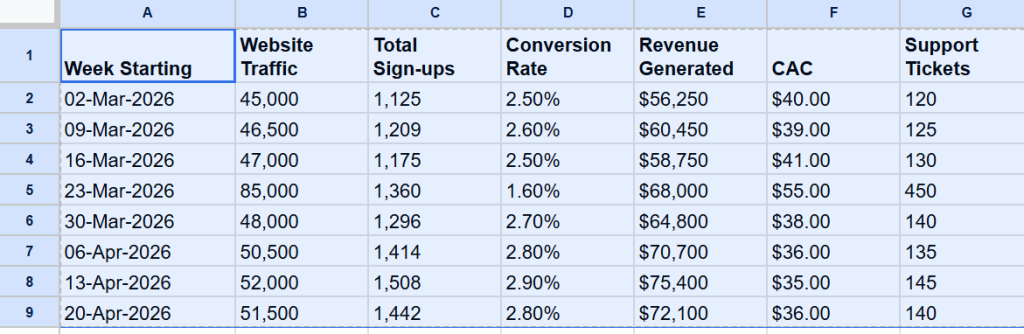
Scenario: You are tasked with a weekly performance report. Traditionally, this process takes 3 – 4 hours: gathering data from various systems, conducting manual analysis, crafting a narrative summary, and formatting the final document. Here’s how you can execute it with AI in a fraction of the time.
Step 1: Prepare and Input the Raw Data
Before the AI can assist, it needs context. In this step, you establish the groundwork for your report by providing the AI with your consolidated metrics. Highlight the data table you’ve inserted into Google Sheets to offer context to the AI.
Step 2: Prompt for Analytical Insights
Instead of manually calculating week-over-week variances, instruct the AI to act as your data analyst. The objective here is to uncover the “why” behind the numbers.
- Open the AI assistant (like the Gemini side panel) and input a highly specific, context-rich prompt requesting data interpretation.
- The Prompt: “Analyze this weekly performance data. Highlight the overarching statistical trends over the 8 weeks, identify any major data anomalies or irregularities, and provide 3 actionable, data-driven business insights based on your findings.”
 Post navigation