Developing reliable AI systems goes beyond just selecting a powerful model. Reliable AI systems are those that consistently deliver accurate and dependable results, even in the face of uncertainty, changing data, and potential failures.
Applied data science involves the practical application of data analysis, statistical analysis, machine learning, and related techniques to solve real-world problems and facilitate data-driven decisions.
Within AI development, applied data science aids in data preparation, pattern identification, model building, performance evaluation, and system enhancement.
The significance of this groundwork becomes more apparent as organizations expand their AI initiatives. According to McKinsey’s 2026 research, over two-thirds of high-performing companies cite data as the primary obstacle to scaling AI.
A practical AI reliability lifecycle can be outlined as:
Data → Analysis → Model Development → Evaluation → Monitoring → Improvement
For instance, a company creating an AI model to predict customer churn may possess a technically robust model but could still generate unreliable predictions if customer data is incomplete, outdated, or poorly represented.
Applied data science aids in identifying such issues and assessing the model’s reliability across relevant customer segments.
Why Data Science Matters for Reliable AI Systems
The role of data science in constructing AI systems commences with comprehending the data utilized for training, testing, and evaluation. Subpar, incomplete, outdated, or biased data can introduce errors that impact model performance, regardless of the algorithm’s technical soundness.
Applied data science assists professionals in scrutinizing datasets, detecting patterns, rectifying inconsistencies, and ascertaining the suitability of available data for the problem at hand. Statistical reasoning aids in distinguishing meaningful patterns from noise and comprehending uncertainty in outcomes.
This becomes especially critical as organizations progress AI projects towards production. Informatica’s 2026 research highlights that 57% of data leaders recognize data reliability as a pivotal hindrance in transitioning AI projects from pilots to production.
For instance, if an AI system is trained to forecast product demand using inconsistent historical sales data, its predictions may appear accurate during testing but perform inadequately upon deployment. Data science aids in uncovering such issues before they impact business decisions.
Therefore, data science is not merely a precursor to model development. It furnishes the methodologies necessary to comprehend data, assess evidence, and construct more reliable AI systems.
How Data Quality Affects AI Reliability
Data quality directly impacts an AI system’s performance. Elements such as accuracy, completeness, consistency, timeliness, and fairness dictate whether AI models yield dependable results.
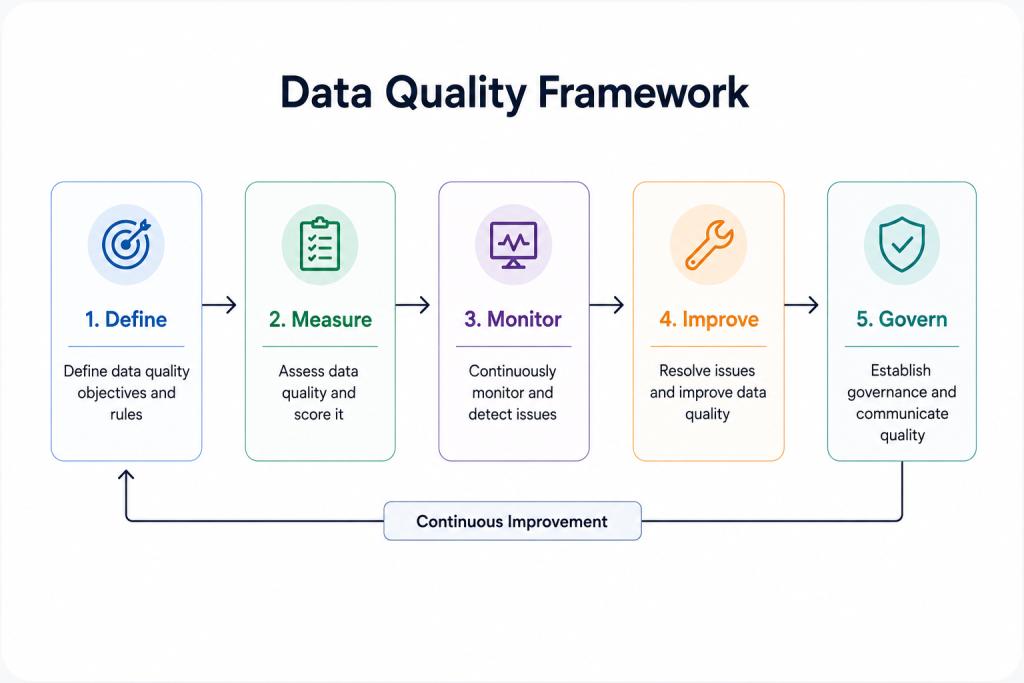
Missing values, outliers, inconsistent records, outdated information, and biased datasets can introduce errors that affect predictions and subsequent decisions.
Applied data science helps tackle these issues through data exploration, cleansing, validation, and transformation. Professionals can pinpoint unusual observations, scrutinize missing information, and evaluate if the dataset accurately represents the problem and target users of the AI system.
The challenge intensifies when AI systems rely on real-time or constantly evolving data.
Confluent’s 2026 Data Streaming Report reveals that 66% of global IT leaders identify uncertainty surrounding data lineage, timeliness, and data quality as a hurdle in scaling AI.
Hence, data preparation should be treated as an ongoing component of AI development rather than a one-time preliminary task.
Reliable inputs establish a more robust foundation for dependable outputs, aiding teams in crafting AI systems that are consistent and apt for real-world utilization.
How Applied Data Science Helps Build and Evaluate AI Models
Applied data science assists professionals in transitioning from prepared data to models that can be tested and enhanced.
Exploratory data analysis can unveil crucial patterns, while feature selection and preparation aid in determining the information that should contribute to a model.
Machine learning techniques can subsequently be applied based on the problem at hand and the available data. Model development represents just one phase in constructing a reliable AI system.
Evaluation aids in determining if the model performs consistently when applied to fresh, unseen data. Professionals also need to evaluate its performance on data it has not encountered previously.
Techniques like cross-validation, error analysis, and appropriate performance metrics can help detect overfitting and other vulnerabilities.
For classification tasks, metrics like precision, recall, and F1-score can be beneficial, while regression assignments might utilize metrics such as MAE or RMSE.
For instance, a model predicting customer churn may exhibit high overall accuracy but falter for a specific customer segment. Analyzing errors and assessing performance across relevant groups can uncover this limitation.
This process aids in addressing a pivotal question: does the model reliably perform beyond the data used for its creation?
Why Statistical Reasoning Is Essential for Reliable AI Decisions
Statistical reasoning assists professionals in ascertaining if data patterns signify meaningful signals and comprehending the uncertainty behind AI-generated outcomes. This enables teams to gauge how much confidence they should place in AI predictions before utilizing them for decision-making.
This is crucial because a model can furnish a prediction without that prediction being equally reliable in every scenario.
Techniques like hypothesis testing, confidence intervals, correlation analysis, and statistical validation can provide supplementary context when analyzing data and assessing model behavior.
For instance, a business might observe that customers receiving a specific offer display higher conversion rates. Statistical analysis aids in determining if the variance is linked to the offer itself or if other factors, like customer segments or seasonal fluctuations, influenced the outcome.
Statistical analysis can help ascertain if the observed variance represents a meaningful relationship or merely stems from random fluctuation.
Statistical reasoning also enables professionals to compare models and gauge if alterations in performance are substantial. This supports better decisions concerning model selection, testing, and deployment.
Ultimately, the role of statistical analysis in supporting AI extends beyond number crunching. It assists professionals in grasping the implications of the evidence, the extent of uncertainty, and the confidence level at which an AI result should be utilized for decision-making.
How Applied Data Science Supports Modern AI Systems
Applied data science remains pivotal as AI transcends conventional machine learning into deep learning, recommendation systems, forecasting, Generative AI, Retrieval-Augmented Generation (RAG), and Agentic AI.
Across these applications, data science underpins data preparation, pattern discovery, evaluation, and continual enhancement.
For instance, a recommendation system can analyze customer behavior to offer personalized product suggestions, while forecasting models can leverage historical sales data to predict future demand.
A RAG application hinges on pertinent and reliable information sources to generate grounded responses, whereas an Agentic AI system might utilize business data to deduce suitable tools or actions.
These applications still rely on data for training, retrieval, evaluation, and ongoing improvement.
Data science aids professionals in preparing pertinent datasets, identifying patterns, gauging performance, and assessing if outputs fulfill the requirements of a specific application.
This becomes increasingly crucial as AI transitions towards real-time applications. Confluent’s 2026 research disclosed that 72% of global IT leaders face challenges in scaling AI due to inadequate real-time data infrastructure.
As systems become more autonomous, data science facilitates upholding the correlation between data, system behavior, evaluation, and real-world outcomes.
How Professionals Can Evaluate AI Systems for Reliability
Evaluating AI reliability surpasses verifying if a model yields accurate outputs. Professionals must also comprehend how the system responds to unseen data, unexpected inputs, edge cases, and changing circumstances.
AI evaluation encompasses accuracy, robustness, bias assessment, fairness checks, explainability, and failure analysis.
Trust is also integral to reliability. Continuous evaluation assists in identifying shifts in performance, emerging failure patterns, or alterations in underlying data.
Teams can then delve into these issues and ascertain if the model or system necessitates adjustments.
The objective is to instill a continuous cycle of testing, monitoring, analysis, and enhancement, aiding professionals in determining not only if an AI system functions but if it remains reliable amidst evolving conditions.
How the MIT Professional Education Applied AI and Data Science Program Builds These Skills
The AI and Data Science course by MIT Professional Education blends data science fundamentals with contemporary AI concepts, empowering professionals to cultivate skills across the AI development lifecycle.
The curriculum spans statistical analysis, data quality, machine learning, deep learning, recommendation systems, Generative AI, and Agentic AI. It also introduces evaluation methodologies and metrics for appraising AI system performance.
By means of real-world case studies, projects, and a capstone, professionals can apply these concepts to tangible predicaments instead of merely grasping them as theoretical constructs.
The program also encompasses evaluation techniques for modern AI applications, including metrics like tool accuracy, ROUGE, BERTScore, and LLM-as-a-Judge. This exposure to diverse approaches for assessing AI outputs based on specific applications and use cases is invaluable.
This program is tailored for professionals aspiring to hone robust expertise in Data Science, Machine Learning, contemporary AI applications, Agentic AI, and AI evaluation methodologies, enabling them to wield AI effectively in tackling real-world business and technical challenges.
Overall, the program interlinks data science, model development, AI evaluation, and modern AI applications, equipping professionals with a broader foundation for constructing and evaluating reliable AI systems.
Final Thoughts
The journey to constructing reliable AI systems does not commence with the model. It commences with grasping the data, employing solid statistical reasoning, evaluating model performance, and persistently monitoring the system.
Applied data science amalgamates these practices, aiding professionals in spotting data issues, constructing apt models, gauging uncertainty, and evaluating AI systems against real-world requisites.
The AI and Data Science course by MIT Professional Education can assist professionals in cultivating these competencies through its coverage of data science, machine learning, deep learning, Generative AI, Agentic AI, and AI evaluation.
Essentially, utilizing data science to forge reliable AI entails establishing a continuous process of:
Data analysis → Model development → Evaluation → Monitoring → Improvement
Frequently Asked Questions
1. What is applied data science in AI?
Applied data science entails leveraging data analysis, statistics, machine learning, and related methodologies to resolve practical challenges. In the realm of AI, it aids professionals in data preparation, model construction, result evaluation, and system enhancement.
2. How does data science enhance AI reliability?
Data science bolsters AI reliability by tackling data quality, model performance, statistical uncertainty, and evaluation. These practices aid in detecting issues before and after an AI system is deployed.
3. Why is data quality crucial for AI systems?
AI models learn from data, hence missing, inconsistent, outdated, or biased data can impact their outcomes. Preparing and validating data lays a sturdier foundation for dependable AI systems.
4. How does statistical analysis buttress AI?
Statistical analysis assists professionals in deciphering patterns, uncertainty, variation, and relationships in data. Techniques like hypothesis testing and confidence intervals offer additional context when evaluating AI results.
5. How can AI models be assessed for reliability?
Models can be evaluated using apt performance metrics, cross-validation, error analysis, robustness testing, bias assessment, and unseen data. Continuous monitoring can also pinpoint performance alterations post-deployment.
6. What skills are imperative for constructing reliable AI systems?
Professionals can benefit from expertise in data preparation, statistical analysis, machine learning, model evaluation, data quality, AI evaluation, and monitoring. Familiarity with Generative AI and Agentic AI can also prove advantageous while working with modern AI systems.
7. Which AI and Data Science course can aid professionals in developing these skills?
The AI and Data Science course by MIT Professional Education encompasses data science and statistical fundamentals, machine learning, deep learning, Generative AI, Agentic AI, and AI evaluation. It also encompasses practical projects and a capstone focused on applying these concepts to real-world predicaments.
8. What delineates a reliable AI system?
A reliable AI system furnishes consistent and trustworthy outcomes across diverse circumstances. Reliability hinges on aspects such as data quality, model evaluation, monitoring, fairness, explainability, and continual enhancement.
9. How does data science bolster Generative AI systems?
Data science bolsters Generative AI by preparing quality data, evaluating generated outputs, evaluating performance, and enhancing system reliability. These practices ensure that AI responses are pertinent, precise, and beneficial.