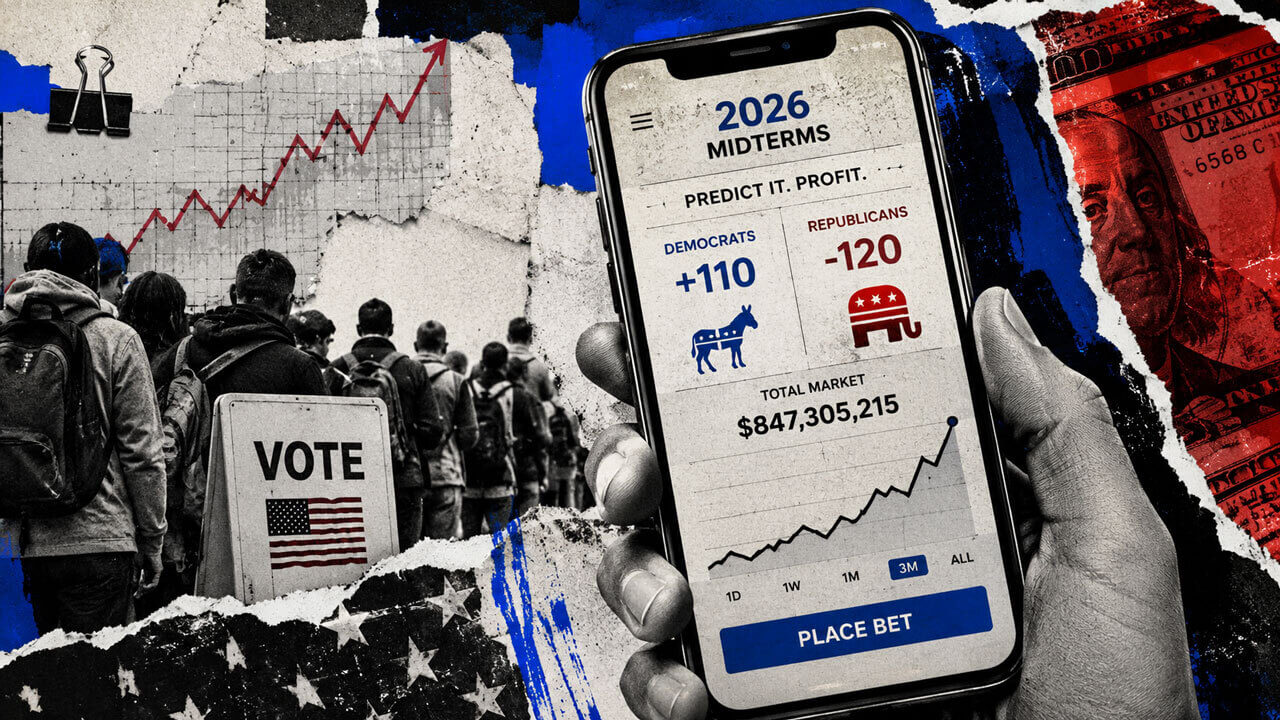
The upcoming midterm election on Nov. 3 is less than 11 weeks away, and the betting market for it has already exceeded the total volume of the 2024 congressional cycle based on the latest comparable data.
By Aug. 10, traders had placed a minimum of $133 million across markets related to House and Senate races, surpassing the $92.4 million total for the entire 2024 cycle. The market now includes 7,466 different markets covering various aspects such as primaries, vote shares, turnout, endorsements, candidate remarks, and winners.
While the overall volume of election betting appears substantial, the participation data reveals a more concentrated scenario. On Polymarket Global, the top 1% of wallets contribute to 68% of congressional volume. Just ten wallets are responsible for 17% of the volume and have traded contracts for 426 out of the 470 seats on the ballot.
Prediction markets are increasingly becoming a key tool for campaigns, donors, and media outlets to interpret elections before voting takes place. However, a small group of capital holders still heavily influences the displayed probability, with enforcement gradually expanding.
Although a concentrated market can generate an accurate price, it can also create a misleading perception of mass opinion when only a few individuals are involved.
Expansion of Market Count Outpaces Audience Growth
An analysis by The Anti-Corruption Data Collective of 7,466 markets across Kalshi, Polymarket, and Polymarket US shows significant growth compared to 2024 in terms of total volume, market count, and time left before Election Day.
| Congressional Betting Measure | 2024 Cycle | 2026 as of Aug. 10 |
|---|---|---|
| Total Volume | $92.4 million | $133 million |
| Comparable Markets | 464 | 7,466 |
| Time Left Before Election Day | Complete | Nearly three months |
| Projected Full-Cycle Volume | Actual: $92.4 million | $1.4 billion to $1.6 billion, conditional |
The upper projection of $1.6 billion is conditional based on the late acceleration seen in 2024. The lower path is estimated at $1.4 billion. The research dashboard will continue to update as the Nov. 3 election approaches.
However, while the market count has expanded significantly, the depth of participation has not kept pace. A few specific contracts account for a large portion of the state-level volume, and the majority of congressional markets have limited participation. This disparity raises concerns about the accuracy and representativeness of the odds.
With the increasing influence of prediction markets in shaping public opinion and informing decision-making, it is crucial to ensure transparency, accountability, and fair participation in these markets.