
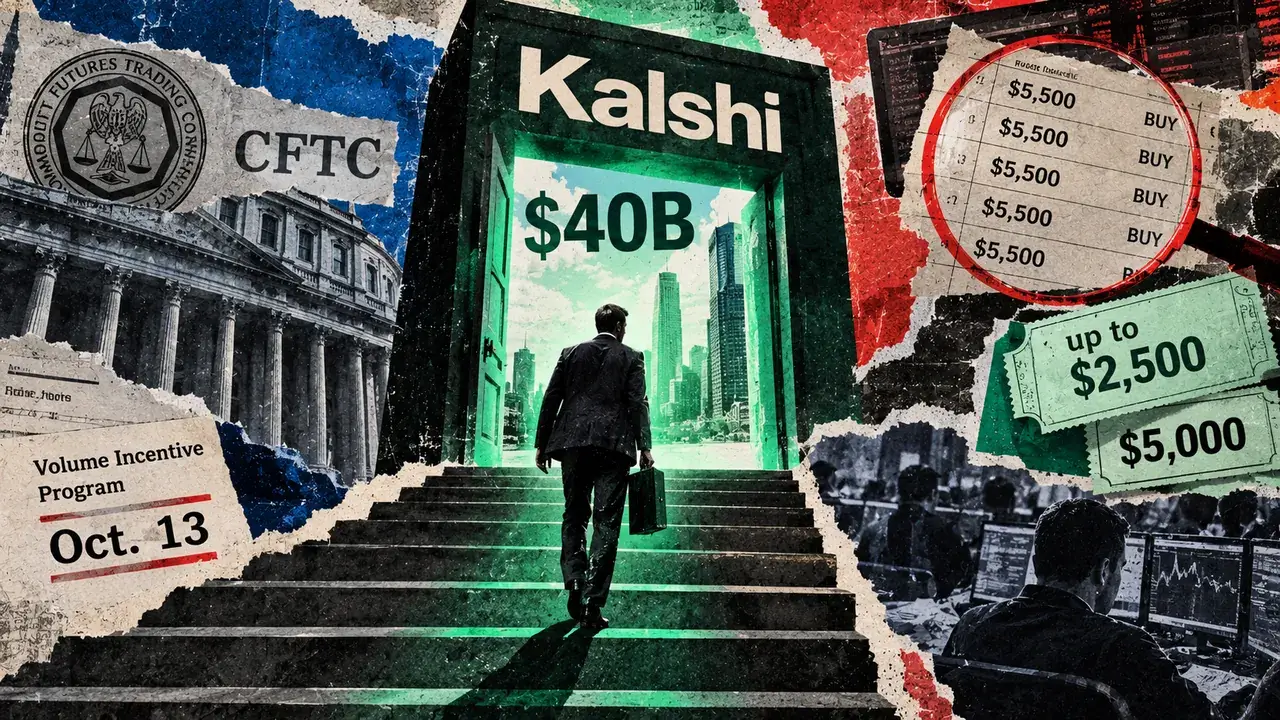
Kalshi is discontinuing its trader-volume incentive program ahead of schedule amidst increased scrutiny of its crypto markets.
The prediction-market operator informed the Commodity Futures Trading Commission (CFTC) that its Volume Incentive Program will end no later than October 13, according to a filing dated September 28. Originally set to run until October 1, 2027, this early termination represents a significant acceleration of the program’s planned closure.
This decision comes as Kalshi faces questions regarding trading patterns in its perpetual futures markets. The CFTC has reportedly looked into activities following the identification of repetitive trades around fixed dollar amounts, including approximately $5,500 in Ethereum perpetuals.
Kalshi has denied any wrongdoing and stated that the repeated transactions are a result of market makers placing fixed-size quotes that other traders consistently hit, rather than wash trading as alleged.
The filing does not explicitly connect the termination of the program to these concerns or provide a reason for ending it early. The exchange had the discretion to terminate the program under its terms.
The Volume Incentive Program was designed to boost activity on Kalshi’s central limit order book by allowing the exchange to specify eligible markets and establish fixed reward pools. Traders would receive a share based on their eligible volume proportion, with rewards capped at half a cent per contract for event-contracts participants. Perpetual futures were also included and exempt from the program’s standard 3-cent to 97-cent qualifying price range.
This incentive structure is now transitioning to a more flexible framework that gives Kalshi greater freedom in attracting and retaining traders.
Kalshi moves towards targeted trader rewards
Shortly before filing to terminate the volume program, Kalshi submitted a new Deposit and Trading Reward Incentive Program to the CFTC. The docket lists a modified version received on September 25, with the filing setting September 28 as the earliest effective date.
These two programs may overlap until the old one ends, but the new framework alters how Kalshi can use incentives.
Instead of distributing a fixed pool based on each trader’s market volume share, Kalshi can now offer time-limited promotions tied to deposits, trading activity, or both. These promotions can last from three to 90 days and target specific groups based on various criteria such as account age, funding status, previous trading activity, inactivity, geographic location, and past participation in specific contract categories.
Individual promotions can pay up to $2,500 per participant, with total rewards capped at $5,000 per person over the planned two-year lifespan of the program. Kalshi can utilize percentage matches or fixed-value incentives across categories including crypto, sports, economics, financials, politics, weather, and entertainment.
The filing also includes more specifics on abusive trading practices. Transactions under scrutiny for potential self-matching, wash trading, prearranged trading, or other prohibited activities would not be eligible for promotional rewards.
Kalshi mentioned that its surveillance team would conduct enhanced monitoring on participants receiving incentives and could revoke eligibility or take disciplinary action.
This targeted customer-acquisition approach gives Kalshi a more precise tool in a landscape where the economics and quality of trading activity on prediction platforms are gaining increased attention.
Record trading backs a $40 billion proposal
The incentive revamp comes despite evidence showing that Kalshi is not struggling to generate significant volume.
The exchange has been setting trading records throughout September. Data compiled by DeFiRate indicates that Kalshi processed a record $3.24 billion on September 27, with weekly volume reaching $15.66 billion in the seven days leading up to that date. Its share of tracked prediction-market volume is around 80%, significantly higher than the levels observed a year ago.
This growth is reflected in the company’s valuation, as Kalshi is reportedly in advanced talks to raise approximately $1 billion at a valuation of about $40 billion. Sequoia Capital and Wellington Management are said to lead the funding round, with Tiger Global and Dragoneer Investment Group also considering investments.
If this deal goes through, it would nearly double Kalshi’s previous $22 billion valuation from a $1 billion fundraising round in May. The company is also exploring expanding beyond prediction markets into other asset classes and has had initial discussions about a potential IPO.
The transition in incentives is not just about the rewards themselves but also about how investors perceive Kalshi’s rapidly growing activity and its ability to sustain customer demand without relying solely on incentive programs to drive trading.