- With the integration of Chainlink Data Streams, Ostium ensures real-time, low-latency, and accurate crypto market pricing.
- This innovative technology combines off-chain speed with on-chain verifiability, enhancing trading precision and mitigating risks like frontrunning, making it ideal for derivatives and high-frequency trading.
Ostium Labs has achieved a significant milestone by becoming the largest decentralized perpetual exchange on Arbitrum, with a total trading volume exceeding $5 billion. This achievement underscores Ostium’s growing influence in the decentralized finance (DeFi) space.
Ostium’s success can be attributed to its strong focus on real-world asset (RWA) markets and a sophisticated backend powered by Chainlink Data Streams.
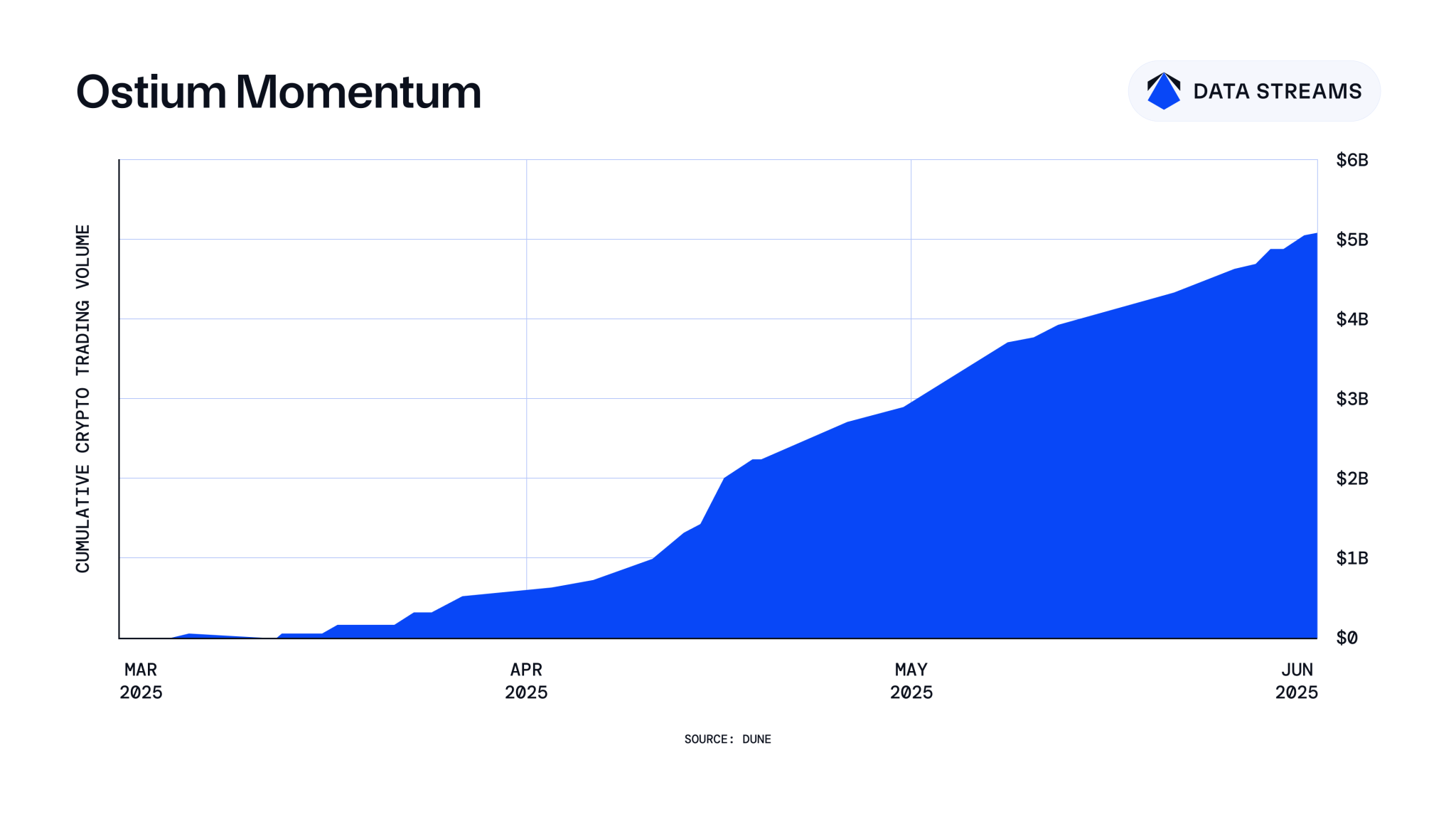
Source: Ostium Labs
To ensure optimal performance and user trust as trading volumes increase, Ostium has integrated Chainlink Data Streams into its infrastructure. This integration enables the exchange to offer real-time, flash, and precise pricing of crypto markets, crucial for high-leverage, real-time trading activities. The partnership between Ostium and Chainlink focuses on low-latency data, transparency, and a composable architecture that leverages Arbitrum’s Layer 2 network.
The Impact of Chainlink Data Streams
Chainlink Data Streams provide real-time market information through a pull style method, empowering decentralized applications to request data as needed. This innovative system replaces push-based oracles with periodic updates or deviation thresholds based on price-to-price bounds. The architecture and implementation of Chainlink Data Streams offer latency and gas savings for trading applications by providing on-demand access to high-frequency pricing data.
Designed to meet the performance requirements of DeFi protocols, Chainlink Data Streams combine off-chain speed with on-chain verifiability. All data values collected by smart contracts are cryptographically signed and immediately verified upon access.
This model ensures that applications receive up-to-date information in real-time, eliminating the risk of stale prices and preventing frontrunning. With sub-second resolution, this technology is well-suited for latency-sensitive applications such as derivatives, prediction markets, and algorithmic trading.
Recent deployments have highlighted how Chainlink’s infrastructure can serve as the backbone for next-generation DeFi solutions, offering centralized-exchange speed while maintaining blockchain-level transparency and security.
Ostium’s Vision for Real-World Asset Perpetuals
Ostium Labs aims to bridge the gap between traditional financial markets and decentralized trading systems. Ostium, its flagship product, is a decentralized perpetual futures-trading exchange designed specifically for trading perpetual futures on RWAs like commodities, currencies, and indices.
Utilizing a synthetic model, the platform allows trading of price movements using stablecoins like USDC. Assets are tracked through internal oracles that adjust prices and fees based on evolving market conditions. The protocol is set to incorporate tokenized real-world assets such as indexes, treasuries, and real estate in the future.
Ostium is designed to cater to both retail and institutional traders, focusing on precision, fast information delivery, and liquidity management. By integrating blockchain-native infrastructure with traditional asset exposure, Ostium sets new standards for efficiently, transparently, and scalably managing RWA trading.